
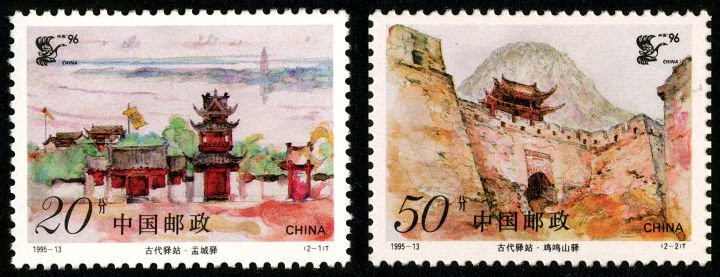
1995-13, Posts in Ancient China《古代驿站》
Stamp Title: Posts in Ancient China
Scott No: 2587, 2588
Serial number: 1995-13
Values in set: 2
(2-1), Mengcheng Post, 20 fen, 40*30mm
(2-2), Jimingshan Post, 50 fen, 40*30mm
Date of issue: August 17, 1995
Designers: Huang Li ;Yan Bingwu
Size: 40*30mm
Perforation: 12
Sheet composition: 50
Printing process: offset
The Yucheng Post in Gaoyou City, according to preliminary textual research, is currently the largest and most completely preserved ancient courier station in China where couriers changed horses and rest. The ruins of the existing Yucheng Post was a building of the Ming dynasty (1368-1644). According to the account in the Chronicles of Gaoyou Prefecture, the post was bukot by Huang Keming, magistrate of the prefecture, outside the southern gate of the town in 1375 and later underwent re-construction for several times. Large-scale repair and expansion were carried out in 1890. The post was abandoned after the founding of the Republic of China in 1911.
The ruins of the Yucheng Post is located outside the southern gate of the old town in Gaoyou City, Jiangsu Province (about 300 meters from the gate of the old town). In The architecture complex of the post by the eastern bank of the ancient canal, there are more than 80 houses of various kinds, covering an area of over 1.3 hectares, which will be larger if all the land affiliated to the post is taken into account. The architecture of the post is exquisite, with the fine wood carvings fully reflecting both the architectural style of the Ming Dynasty and the rich substance of the folk custom and local culture in northern Jiangsu.
The Jimingshan Post in Huailai County of Hebei Province is named after the Jiming Mountain in the north, Also called Jiming Post, it was formerly under the jurisdiction of Prefecture of Xuanhua and the only one on the road from Xuanhua to the capital. It is the existing well-preserved ancient courier station in China with the biggest floor space.
According to the Chronicles of Xuanhua Prefecture, the Jimingshan Post was constructed in 1420 and its earthen wall was built in 1471 before repair and reconstruction were done for several times. The square post covers a total area of some 200,000 square meters and is enclosed by more than 1,800 meters of 10-meter-high earthen wall, with office rooms for officials in charge, post house, warehouse, stable and drill ground inside. The post house in the northwest is a brick-wood residential compound with three rows of houses in the style of the Ming Dynasty.
-

- (2-1), Mengcheng Post, 20 fen, 40*30mm
-
- (2-2), Jimingshan Post, 50 fen, 40*30mm

1995年特种邮票《古代驿站》
国家邮政局1995年8月17日发行《古代驿站》特种邮票1套2枚。
(2-1)T 盂城驿 20 分 3131.75万枚
(2-2)T 鸡鸣山驿 50 分 2501.75万枚
志号名称:1995-13T
版别:胶印
整版枚数:50枚
全套面值:0.70元
邮票规格:40 × 30毫米
齿孔度数:12 度
设计者:黄里、阎炳武
印制机构:河南省邮电印刷厂
驿站是古代供传递宫府文书和军事情报的人或来往官员途中食宿,换马的场所。我国是世界上最早建立组织传递信息的国家之一。在尧舜时代,便设有管理通信的官。到夏王朝,设有车正官吏,管理民间通信。周代就已在交通要道上设置馆舍,为过往官员和驿使提供食宿,更换车马;传送官府文书、信扎、军事情报;运送各类物资等等。秦王朝时期不但建立了以国都咸阳为中心的全国驿站网,而且制定形成了一套邮驿管理的法令和制度,具体又明确地规定了那时文书的呈送传递、邮传机构管理、人员条件、时间要求、奖惩、驿马饲养等事宜。汉代汉武帝为了加强国际经济文化交流,开始建立国际邮路,从首都长安西行,经过甘肃、新疆,直通波斯和罗马帝国,这就是著名的丝绸之路。沿途修筑驿站,设置邮亭,传递公文的驿骑日夜奔驰。东汉起,“驿传”在中国历史上出现。魏晋时期成为“邮驿”。同时制定了我国历史上第一个《邮驿令》。唐代把“驿”称作“馆”,建驿馆制度。宋代分别组织步递、马递和“急递铺”传送。急递铺为元、明、清三代沿袭,成为传递公文的常设机构。光绪三十二年(公元1906年)十一月邮传部成立。1911年辛亥革命推翻了清王朝,为封建王朝服务的邮驿也随之消亡。至此,我国3000多年的驿运史宣告结束。我国邮驿历史虽长达3000多年,但留存的遗址、文物并不多。
1995年8月17日,为了宣传我国古代邮驿的历史和成就,促进邮驿文物的保护和发掘,邮电部发行了《古代驿站》特种邮票,全套2枚。
Leave A Comment
You must be logged in to post a comment.