

1995-14, The 1500th Anniversary of the Shaolin Temple《少林寺建寺1500年》
Stamp Title: The 1500th Anniversary of the Shaolin Temple
Scott No: 2589, 2590, 2591, 2592
Serial number: 1995-14
Values in set: 4
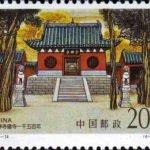
(4-1), Gate of Shaolin Temple, 20 fen, 40*30mm
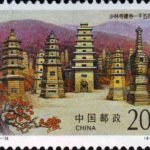
(4-2), Pagodas in Shaolin Temple, 20 fen, 40*30mm
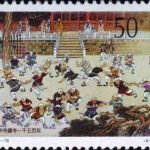
(4-3), Buddhists are learning Wushu, 50 fen, 40*30mm
(4-4), Thirteen Buddhists Saved Qing Prince, 100 fen, 40*30mm
Date of issue: August 30, 1995
Designers: Li Defu; Yang Wenqing
Size: 40*30mm
Perforation: 12
Sheet composition: 50
Printing process: offset
The Shaolin Temple in Mt.Songshan is the source of the Zen sect of Buddhism and birthplace of the Shaolin martial arts. When an eminent monk came from India to do Missionary work in China during the Northern Wei Dynasty (386-534), a temple was built for him by Xiaowen Empeor in the wood at the northern side of the Shaoshi Mountain, hence the name of the Shaolin Temple. Later the Indian eminent monk Bodhidharma came and founded the Zen sect of Buddhism in the Shaolin Temple. In history, Bodhidharma is regarded as the founder of the Zen sect of Buddhism and the Shaolin Temple as the place where the founder lives. The Zen sect of Buddhism advocates the epitomization of all the moral teachings of Buddhism with deep meditation. After the Tang Dynasty (618-907), Zen gradually developed into a major school of Buddhism. The thoughts of Zen had an important impact on the ancient culture of China. According to historical materials, in early Tang Dynasty, the monks of the Shaolin Temple made important contribution to the first emperor of the Tang Dynasty, Tai Zong, in founding the dynasty and had approved by the emperor to practice boxing. The Shaolin martial arts have enjoyed a great reputation for long and have been widely spread.
The existing architectures of the Shaolin Temple include the main gate, abbot’s room, Bodhidharma Pavilion, the Hall of White Cloth and the Hall of Countless Buddha Statues. In the Hall of Countless Buddha Statues, there is the more than 300-meter-long wall painting of the Five Hundred Arhats Paying Religious Homage to Vairocana dated back to the Ming Dynasty (1368-1644). Precious cultural relics also include the wall paintings of the Qing Dynasty (1644-1911) preserved in the Hall of white Cloth on the record of the Shaolin boxing and the 13 Shaolin monks helping Li Shimin (the first emperor of the Tang Dynasty) break out of an encirclement. The Tower Forest in the west of the temple is the cemetery of monks for generations and is composed of more than 220 brick-stone towers of different forms that were built between Tang and Qing dynasties. It is a treasure-house for the comprehensive study of the art of brick-stone architecture and sculpture in ancient China. Also well preserved in the temple are more than 300 steles since the Tang Dynasty.
Today the old Shaolin Temple has become a famous spot of Buddhism and a tourist attraction.
-

- (4-1), Gate of Shaolin Temple, 20 fen, 40*30mm
-
- (4-2), Pagodas in Shaolin Temple, 20 fen, 40*30mm
-
- (4-3), Buddhists are learning Wushu, 50 fen, 40*30mm
-
- (4-4), Thirteen Buddhists Saved Qing Prince, 100 fen, 40*30mm

1995年纪念邮票《少林寺建寺1500年》
国家邮政局1995年8月30日发行《少林寺建寺1500年》纪念邮票1套4枚。
(4-1)J 少林寺山门 20 分 5249.25万枚
(4-2)J 少林寺塔林 20 分 5249.25万枚
(4-3)J 众僧徒习武 50 分 3149.25万枚
(4-4)J 十三僧救秦王 100 分 2601.75万枚
志号名称:1995-14J
版别:胶印
整版枚数:50枚
全套面值:1.90元
邮票规格:40×30毫米
齿孔度数:12 度
设计者:李德福、杨文清
印制机构:河南省邮电印刷厂
少林寺在河南登封县西北,少室山北麓、五乳峰下茂林之中。始建于北魏年间由印度高僧普提达摩开拓,为我国佛教禅宗之“祖庭”,号称“天下第一刹”。现在建筑为明清时重建;中轴建筑七进,总面积三万平方米。千佛殿规模宏大,殿内保留有300多平方米的大幅明代壁画《五百罗汉朝毗户》。
大殿地面尚留有操演少林拳的遗迹,闻名中外的少林武术就源于此。寺内有各代所建的殿、享、塔等,在我国建筑史上都占有重要的地位。
Leave A Comment
You must be logged in to post a comment.