
-
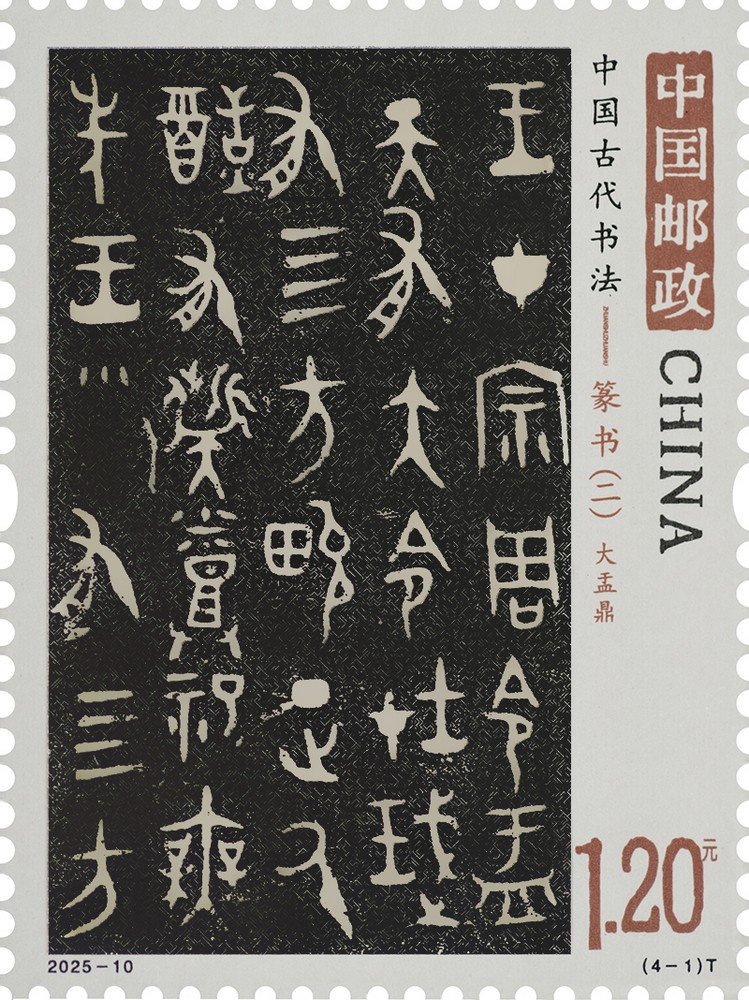
- 2025‑10‑1, Yu Bronze Ding | 2025‑10‑1,中国古代书法‑篆书(二)(4‑1)大盂鼎
-

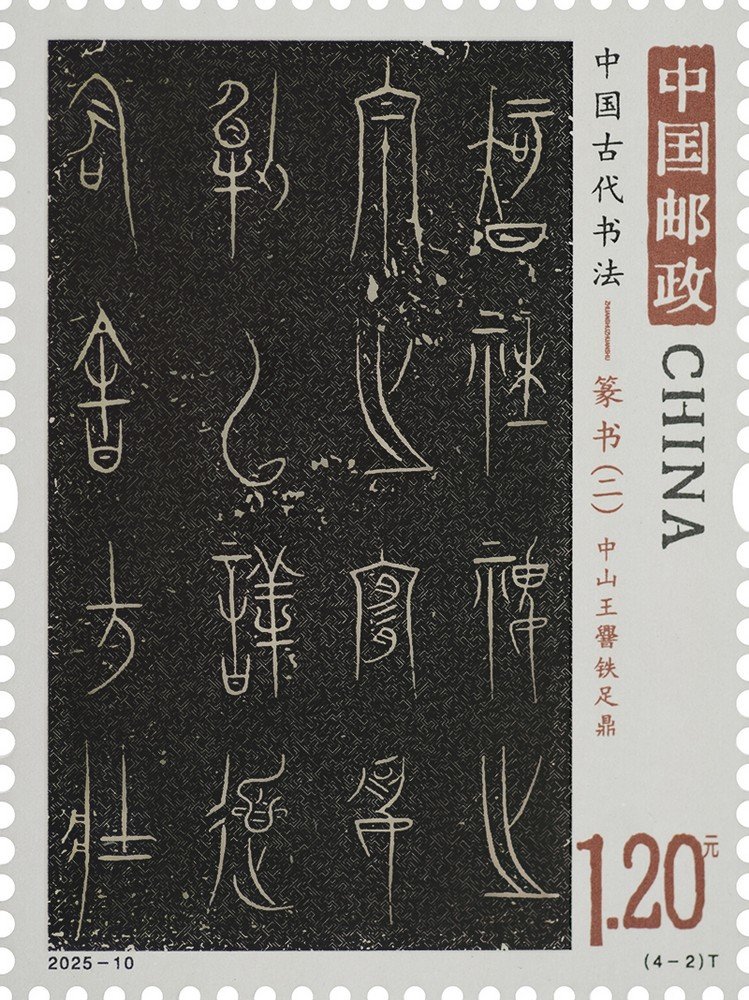
- 2025‑10‑2, Iron‑Footed Tripod of King Cuo of Zhongshan | 2025‑10‑2,中国古代书法‑篆书(二)(4‑2)中山王铁足鼎
-
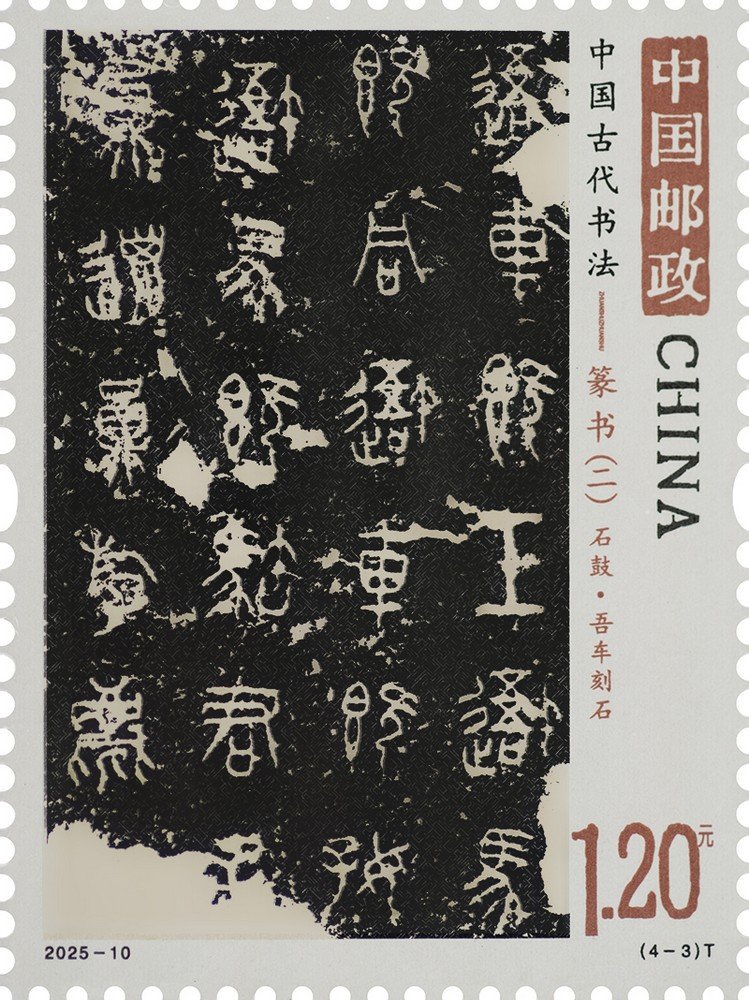
- 2025‑10‑3, Wu Che’ Stone Drum | 2025‑10‑3,中国古代书法‑篆书(二)(4‑3)石鼓·吾车刻石
-
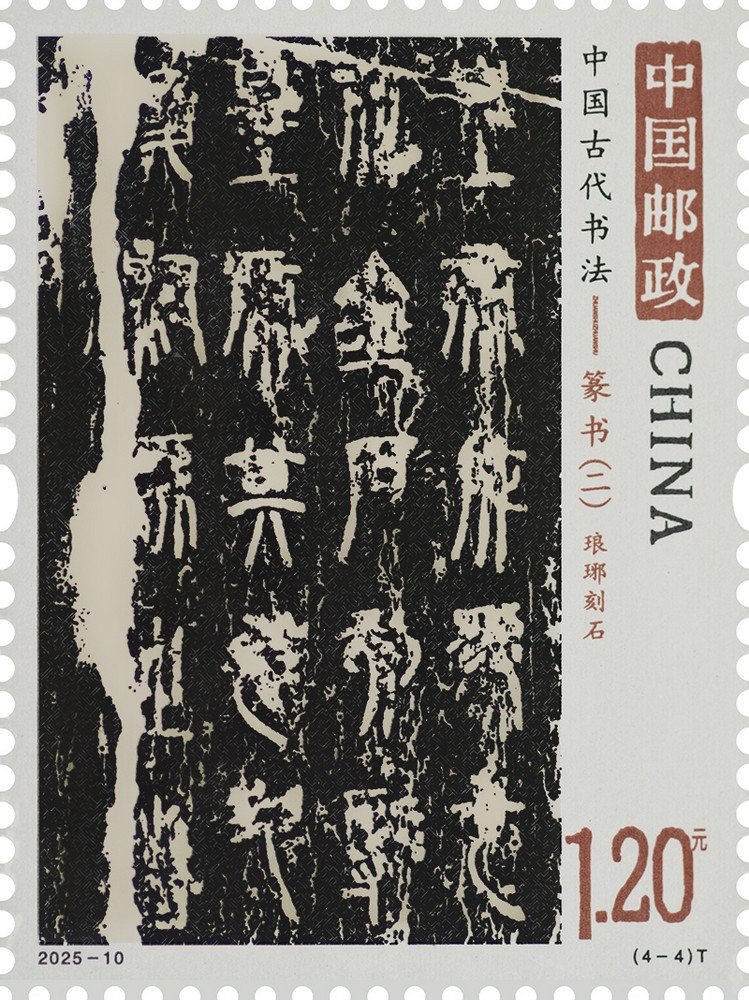
- 2025‑10‑4, Inscribed Stone Tablet from Langya | 2025‑10‑4,中国古代书法‑篆书(二)(4‑4)琅琊刻石
Stamp Title: Ancient Chinese Calligraphy – Seal Script (2)
Serial number: 2025-10
Values in set: 4
(4-1), Yu Bronze Ding, 120 fen, 30 * 40 mm
(4-2), Iron-Footed Tripod of King Cuo of Zhongshan, 120 fen, 30 * 40 mm
(4-3), Wu Che’ Stone Drum, 120 fen, 30 * 40 mm
(4-4), Inscribed Stone Tablet from Langya, 120 fen, 30 * 40 mm
(1-1m), Wine Vessel of He, 600 fen, 65 * 70 mm/ 150 * 90 mm
(1-1s), Ancient Chinese Calligraphy – Seal Script (2) (Mini Sheet), 960 fen, 135 * 200 mm
Date of issue: June 21st, 2025
Denomination: 480 fen
Designer: Xing Wenwei
Size of stamps: 30 * 40 mm
Perforation: 13.5
Sheet composition:
16 for Sheet I;
8 for Sheet II (2 sets)
Size of sheet:
150 * 200 mm for Sheet I;
135 * 200 mm for Sheet II
Size of S/S: 150 * 90 mm
Size of S/S stamp: 65 * 70 mm
S/S Perforation: 13
Printing process:
Stamps: Offset + Engraving
S/S: Photogravure
Printing House: Beijing Postage Stamp Printing Works
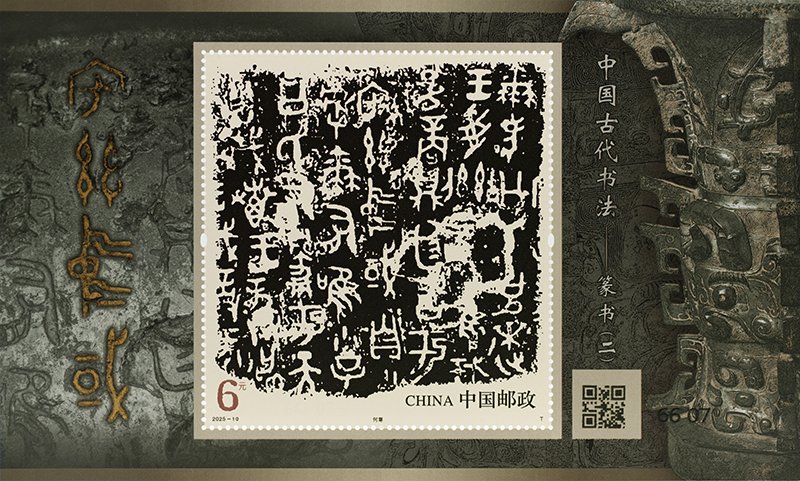
2025‑10‑m, Wine Vessel of He (Miniature Sheet) | 2025‑10‑m,中国古代书法‑篆书(二)小型张 何尊
Background:
China Post plans to issue a set of 4 special stamps and 1 souvenir sheet themed Ancient Chinese Calligraphy – Seal Script (II) on June 21, 2025. The stamps are titled Dayu Cauldron, Iron-footed Cauldron of King Zhongshan of the Warring States Period, Stone Drum · Carving of “My Chariot”, and Langya Stone Carving respectively, while the souvenir sheet is themed He Zun. The total face value of the complete stamp set is 4.80 yuan, and the face value of the souvenir sheet is 6 yuan. The planned issuance volume is 5.9 million sets of regular stamps, 693,000 sheets of Format 2, and 4.7 million souvenir sheets.
General Secretary Xi Jinping pointed out: “Calligraphy is a treasure of Chinese culture that embodies profound spiritual essence, and we must pass it on and carry it forward with great dedication.” Ancient Chinese calligraphy boasts a long and splendid history. It is not merely a way of writing characters, but also an artistic form for expressing personal emotions, thoughts and philosophical concepts. Tracing back to the oracle bone script era thousands of years ago, ancient Chinese calligraphy has gone through multiple stages of development, evolving into five major styles: seal script, clerical script, regular script, running script and cursive script. Over time, various schools and styles with unique characteristics and aesthetic values have emerged. Bronze artifacts, stone steles and calligraphy albums are important carriers of calligraphic art. Inscriptions on bronzes and stone carvings, thanks to the durability of their materials, have become crucial forms for inheriting calligraphy. Calligraphy albums, on the other hand, have facilitated the widespread dissemination of calligraphic art due to their ease of reproduction and circulation.
This set of stamps selects five precious cultural relics and conveys the millennia-old charm of seal script through rubbings of their bronze inscriptions and stone carvings. The Dayu Cauldron gets its name from Yu, a minister of King Kang of the Western Zhou Dynasty who ordered its casting. Featuring profound and solemn bronze script, it takes the first place in the set. With plump and straight strokes, it is recognized as an outstanding representative of bronze script calligraphy in the early Western Zhou Dynasty. The outer wall of the Iron-footed Cauldron of King Zhongshan of the Warring States Period is covered with 77 lines of inscriptions, totaling 469 characters, making it the Warring States bronze artifact with the longest inscriptions discovered so far. Its inscriptions, displaying elegant and flowing decorative charm, are a rare treasure among ancient Chinese characters from the pre-Qin period. The Stone Drums are a group of granite carvings shaped like round drums. During the Qin Dynasty, ten four-character poems were inscribed on the ten drum-shaped boulders, depicting the grand scenes of the monarch’s hunting trips, and “My Chariot” is one of these drums. Known as the ancestor of stone carvings, the scripts on the Stone Drums record the stylistic transition from archaic seal script to small seal script. The Langya Stone Carving preserves a model of small seal script created by Li Si and ranks among China’s earliest stone carvings. It serves as a landmark work representing the unification of Chinese characters in the Qin Dynasty. Though only the edict of the Second Emperor of Qin remains, it still bears the historical trace of the “unification of writing systems across the realm”.
The souvenir sheet features the He Zun from the Western Zhou Dynasty. The inscription “Establish the Capital Here in the Central Kingdom” on it is not only the earliest physical and documentary evidence of the term “China” but also the source of inspiration for the design of China Post’s logo.
The stamps are produced using the offset and engraving combination process. The background color of the inner image simulates the effect and texture of rubbings through three-dimensional carved patterns, while the color of the border decorations mimics the texture of paper, making the stamp content highly consistent with real rubbings. The souvenir sheet adopts the photogravure printing process, presenting clear images with rich layers. The full spot color separation printing enhances its anti-counterfeiting performance. The characters “China” in the image are designed with fluorescent effects, and the border inscription “Establish the Capital Here in the Central Kingdom” adopts the gold embossing process, which highlights the historical sense of the bronze artifact through textured effects. The bronze artifact on the right is painted in calm and distinct layers, embodying the mysterious and profound temperament of the He Zun.
The set of stamps is designed by Xing Wenwei, and the souvenir sheet by Ma Lihang. It is edited by Gan Zhige. Beijing Stamp Printing Co., Ltd. produced the stamps using the offset and engraving combination process, and the souvenir sheet via the photogravure printing process.
中国邮政2025年6月21日发行《中国古代书法 – 篆书(二)》特种邮票1套4枚,小型张1枚。
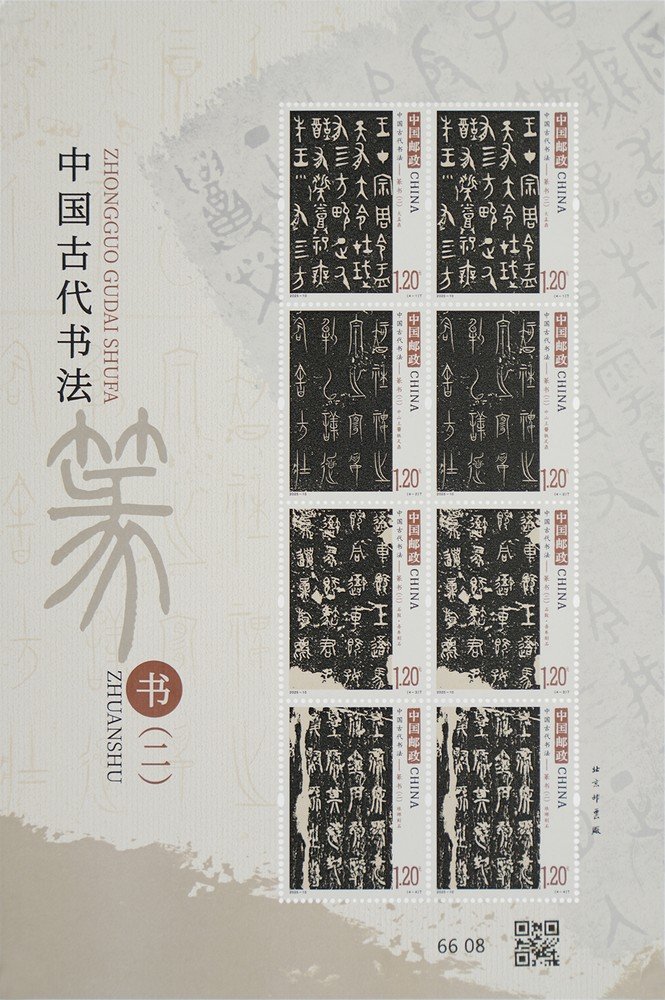
2025‑10‑s, Ancient Chinese Calligraphy‑Seal Script (2) Mini Sheet | 2025‑10‑s,中国古代书法‑篆书(二)小全张
(4-1)T 大盂鼎 1.20元
(4-2)T 中山王铁足鼎 1.20元
(4-3)T 石鼓·吾车刻石 1.20元
(4-4)T 琅琊刻石 1.20元
小型张 何尊 6.00元
志号:2025-10
邮票规格:30×40毫米
齿孔度数:13.5度
整张枚数:版式一 16枚,版式二 8枚(2套)
整张规格:版式一 150×200毫米,版式二 135×200毫米
小型张:邮票规格65×70毫米、外形规格150×90毫米、齿孔度数13度
版别:胶雕套印(邮票)、影写(小型张)
防伪方式:防伪纸张、防伪油墨、异形齿孔、荧光喷码
设计者:邢文伟(邮票)、马立航(小型张)
资料提供:上海图书馆(上海科学技术情报研究所)、河北省文物考古研究院、宝鸡青铜器博物院
责任编辑:干止戈
印制厂:北京邮票厂有限公司
计划发行数量:套票590万套,版式二69.3万版,小型张470万枚
P.S. 中国古代书法有着悠久而辉煌的历史,它不仅是文字的书写形式,更是一种表达个人情感、思想和哲学观念的艺术形式。中国书法可以追溯到几千年前的甲骨文时期。随着历史的发展,中国书法经历了多个阶段的发展,形成了五种主要的书体:篆书、隶书、楷书、行书和草书,并且逐渐形成了多种风格和流派,每一种都有其独特的特点和美学价值。青铜器、碑、帖都是书法艺术的重要载体。铭文和碑刻因其材质的坚硬耐久,成为书法艺术传承的重要形式;而帖则因为便于复制和流传,使得书法艺术得以广泛传播。
本套邮票精选五件文物,通过其青铜铭文与石刻文字拓片,传递千年篆韵。大盂鼎因作器者为西周康王之臣盂而得名,以其浑厚庄重的金文位列首枚,笔画丰腴挺拔,堪称西周早期金文书法艺术的杰出代表;战国中山王铁足鼎的外壁刻满了77行铭文,共计469个字,是目前发现的铭文最长的战国青铜器,铭文展现绮丽飘逸的装饰趣味,是先秦古文字精品奇珍;石鼓是形似圆鼓的一组花岗岩刻石,秦人曾在十面鼓形巨石上刻下十首四言诗,记述君主的游猎盛景,吾车为其中一面,石鼓文作为石刻之祖,记录了大篆向小篆过渡的笔意;琅琊刻石则留存李斯小篆的典范,是中国最早的刻石之一,是秦朝统一全国文字的典范之作,虽仅存秦二世诏书部分,仍可窥见“书同文”的历史印记。小型张选用西周何尊,其“宅兹中国”铭文不仅是“中国”一词最早实物与文献见证,也成为中国邮政标志的设计灵感来源。
邮票采用胶雕套印工艺,内图底色通过立体雕刻纹路模拟拓印效果和质感,边饰颜色模拟纸张纹路,使邮票内容更贴近真实拓印效果。小型张采用影写印刷工艺,画面清晰,层次丰富,通过全专色分色印刷提高邮票防伪性。图内“中国”二字设计荧光效果,邮票边饰“宅兹中国”采用金色直压工艺,通过纹理效果体现青铜器历史感。右侧青铜器用色沉稳,层次鲜明,体现出何尊的神秘厚重感。
Leave A Comment
You must be logged in to post a comment.