
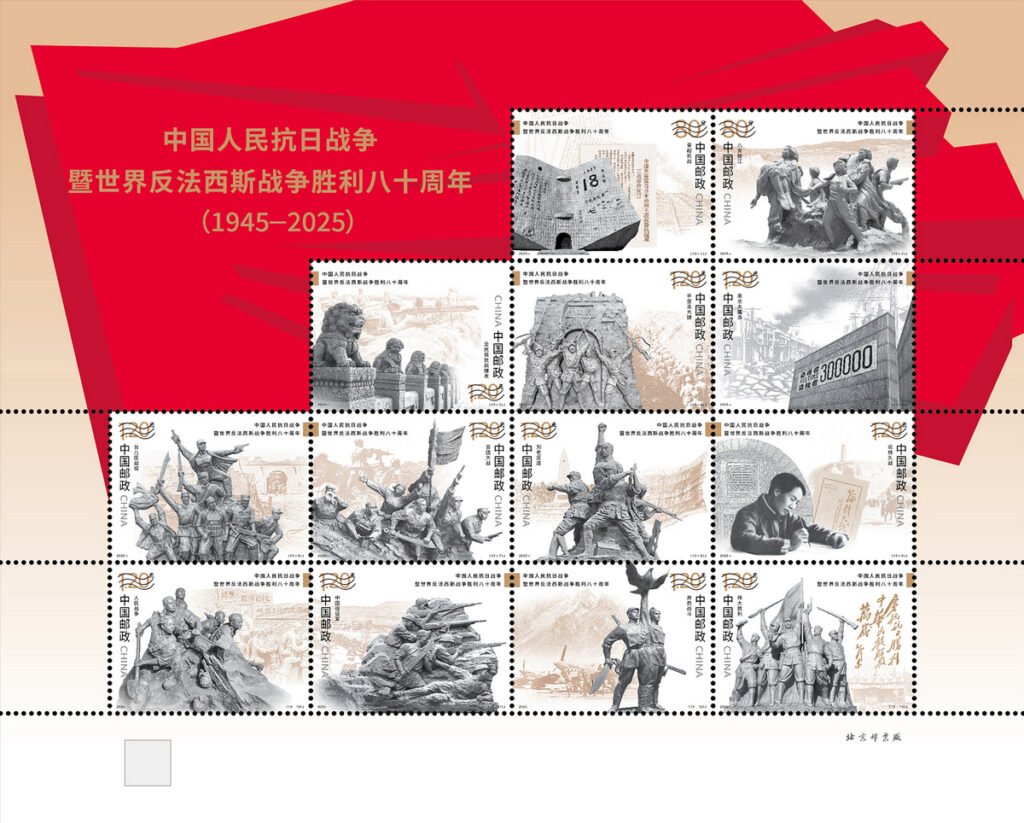
2025‑18 Full Sheet of Commemorative Stamps|抗战胜利八十周年邮票大版
Commemorative Stamps: 80th Anniversary of the Victory of the Chinese People’s War of Resistance Against Japanese Aggression and the World‑Anti‑Fascist War (2025‑18)
China Post issued a set of thirteen commemorative stamps plus one souvenir sheet for the 80th Anniversary of the Victory of the Chinese People’s War of Resistance Against Japanese Aggression and the World‑Anti‑Fascist War on September 3, 2025.
(13‑1) J Rise to Resist Japanese Aggression 0.80 CNY
(13‑2) J Eight Heroines Drowning Themselves 0.80 CNY
(13‑3) J Outbreak of the Nation‑Wide War of Resistance 1.20 CNY
(13‑4) J Great Victory at Pingxingguan 1.20 CNY
(13‑5) J Nanjing Massacre 1.20 CNY
(13‑6) J Battle of Taierzhuang 1.20 CNY
(13‑7) J Hundred‑Regiments Offensive 1.20 CNY
(13‑8) J Liuzhuanglian Company 1.20 CNY
(13‑9) J On Protracted War 1.20 CNY
(13‑10) J People’s War 1.20 CNY
(13‑11) J Chinese Expeditionary Force 1.20 CNY
(13‑12) J Fight Side‑by‑Side 1.20 CNY
(13‑13) J Great Victory 1.20 CNY
Souvenir‑sheet: 80th Anniversary of the Victory of the Chinese People’s War of Resistance Against Japanese Aggression and the World‑Anti‑Fascist War 6.00 CNY
Serial No.: 2025‑18
Stamp size: 44 × 33 mm | Perforation:13 degrees
Stamps per full sheet:13 units (one complete set)
Full‑sheet size:224 × 180 mm
Souvenir‑sheet stamp size:50 × 60 mm
Souvenir‑sheet outer size:80 × 118 mm
Souvenir‑sheet perforation:13 degrees
Printing process: Offset printing
Security features: Security paper, security ink, special‑shaped perforations, fluorescent coding
Designer: Collective creation of Beijing Stamp Factory Co., Ltd.
Data sources: September‑18th History Museum, Chinese People’s Revolutionary Military Museum, Pingxingguan‑Great‑Victory Memorial Hall, Memorial Hall of the Victims in Nanjing Massacre by Japanese Invaders, Taierzhuang‑Battle Memorial Hall, Publicity Department of Yangquan Municipal CPC Committee, Publicity Department of Huaiyin District Huai’an CPC Committee, Central Archives, Chinese People’s War‑of‑Resistance‑Against‑Japanese‑Aggression Memorial Hall, Mine‑War Memorial‑Hall of Haiyang, Western‑Yunnan War‑of‑Resistance‑Against‑Japanese‑Aggression Memorial Hall, Housing and Urban‑Rural Development Bureau of Gaoyou City
Printer: Beijing Stamp Factory Co., Ltd. (stamps); Henan Post & Telecom Technology Co., Ltd. (souvenir sheet)
Planned print run: 6.00 million sets; souvenir‑sheet: 5.00 million pieces
Total face‑value of complete set (stamps + souvenir‑sheet): CNY 20.80
This commemorative stamp set takes the 14‑year‑long course of China’s War of Resistance Against Japanese Aggression as its main storyline, highlights major campaigns and battles, adopts anti‑Japanese‑war‑themed sculptures as its primary artistic form, and uses historical photographs as background material for creation. Stamps No. 1‑13 interpret the theme “Remember History, Honor Fallen Heroes”.
(13‑1) Rise to Resist Japanese Aggression: Foreground: the Broken‑Calendar Monument at September‑18th History Museum. Background: the September 20 1931 Manifesto issued by the CPC Central Committee, and the Liutiaohu railway section blown‑up by Japanese troops.
(13‑2) Eight Heroines Drowning Themselves: Foreground: sculpture Eight Heroines Drowning Themselves from the Chinese People’s Revolutionary Military Museum. Background: bank of the Usuhun River in Heilongjiang Province.
(13‑3) Outbreak of the Nation‑Wide War of Resistance: Foreground: stone lions at Lugou Bridge. Background: soldiers of the 29th Army guarding Lugou Bridge.
(13‑4) Great Victory at Pingxingguan: Foreground: theme sculpture in the pre‑hall of Pingxingguan‑Great‑Victory Memorial Hall. Background: the 115th Division of the Eighth Route Army advancing toward Pingxingguan.
(13‑5) Nanjing Massacre: Foreground: memorial wall with “300 000 Victims” inscribed in Chinese‑English‑Japanese at the Memorial Hall of the Victims in Nanjing Massacre by Japanese Invaders. Background: Nanjing city burnt‑down and destroyed by Japanese troops.
(13‑6) Battle of Taierzhuang: Foreground: relief Unite and Resist Aggression in Taierzhuang‑Battle Memorial Hall. Background: city gate of Taierzhuang after combat.
(13‑7) Hundred‑Regiments Offensive: Foreground: partial view of theme‑sculpture Hundred‑Regiments Offensive, Glory Through the Ages in the pre‑hall of Hundred‑Regiments‑Offensive Memorial Hall. Background: machine‑gun position of Eighth Route Army in the Shinao‑shan battle.
(13‑8) Liuzhuanglian Company: Foreground: sculpture Pillar at the New Fourth Army Liuzhuanglian Memorial Park. Background: Monument to the Eighty‑Two Martyrs and the company flag of “Liuzhuanglian”.
(13‑9) On Protracted War: Foreground: Mao Zedong writing On Protracted War in Yan’an cave‑dwelling. Background: book‑facsimile of On Protracted War, Baota Mountain of Yan’an, cavalry‑troops of the Garrison Corps of the Shaanxi‑Gansu‑Ningxia Border Region.
(13‑10) People’s War: Foreground: sculpture Five Tiger Generals at the Mine‑War Memorial‑Hall of Haiyang, Shandong. Background: relief of mothers sending sons to the battlefield plus slogans: “Good men take‑up‑arms for the front”, “Resist Japan and Save the Nation”, “Unity”.
(13‑11) Chinese Expeditionary Force: Foreground: partial view of theme‑sculpture Chinese Expeditionary Force in pre‑hall of Western‑Yunnan War‑of‑Resistance‑Against‑Japanese‑Aggression Memorial Hall. Background: marching Chinese Expeditionary Force.
(13‑12) Fight Side‑by‑Side: Foreground: sculpture Defend Peace in Chinese People’s War‑of‑Resistance‑Against‑Japanese‑Aggression Memorial Hall. Background: Flying‑Tigers, Hump Airlift route.
(13‑13) Great Victory: Foreground: Mao Zedong’s inscription “Celebrate Victory of Resistance‑Against‑Japan, Long Live the Liberation of the Chinese Nation” published in Xinhua Daily Sep 3 1945; plus sculpture Moment of Victory at the former‑site where Japanese invaders surrendered to the New Fourth Army. Background: Yan’an populace celebrating victory of the war of resistance.
The souvenir‑sheet uses the official logo for the 80th‑anniversary commemorative activities as main visual element, conveying the theme “Cherish Peace, Create the Future”.
This stamp set well reflects the theme of the commemorative event and promotes the great spirit of the War of Resistance Against Japanese Aggression. Solemn and weighty, it possesses strong artistic appeal, historical expressiveness and visual impact. It vividly presents the arduous 14‑year‑long war‑of‑resistance of the Chinese people, highlights the CPC’s role as the mainstay and China’s position as the Eastern main battlefield of World‑Anti‑Fascist War.
《中国人民抗日战争暨世界反法西斯战争胜利八十周年》纪念邮票(2025‑18)
中国邮政2025年9月3日发行《中国人民抗日战争暨世界反法西斯战争胜利八十周年》纪念邮票1套13枚,小型张1枚。
(13‑1)J 奋起抗战 80分
(13‑2)J 八女投江 80分
(13‑3)J 全民族抗战爆发 1.20元
(13‑4)J 平型关大捷 1.20元
(13‑5)J 南京大屠杀 1.20元
(13‑6)J 台儿庄战役 1.20元
(13‑7)J 百团大战 1.20元
(13‑8)J 刘老庄连 1.20元
(13‑9)J 论持久战 1.20元
(13‑10)J 人民战争 1.20元
(13‑11)J 中国远征军 1.20元
(13‑12)J 并肩战斗 1.20元
(13‑13)J 伟大胜利 1.20元
小型张:中国人民抗日战争暨世界反法西斯战争胜利八十周年 6元
志号:2025‑18
邮票规格:44×33毫米|齿孔度数:13度
整张枚数:13枚(1套)
整张规格:224×180毫米
小型张邮票规格:50×60毫米
小型张外形规格:80×118毫米
小型张齿孔度数:13度
版别:胶印
防伪方式:防伪纸张、防伪油墨、异形齿孔、荧光喷码
设计者:北京邮票厂有限公司集体创作
资料提供:“九·一八”历史博物馆、中国人民革命军事博物馆、平型关大捷纪念馆、侵华日军南京大屠杀遇难同胞纪念馆、台儿庄大战纪念馆、中国共产党阳泉市委员会宣传部、中共淮安市淮阴区委宣传部、中央档案馆、中国人民抗日战争纪念馆、地雷战纪念馆、滇西抗战纪念馆、高邮市住房和城乡建设局
印制厂:北京邮票厂有限公司(邮票),河南省邮电科技有限公司(小型张)
计划发行数量:套票600万套,小型张500万枚
全套(套票+小型张)总面值:20.80元
该套纪念邮票以反映14年抗战历程为主线,以重要战役战斗为展示重点,以抗战题材雕塑为主要表现形式,以历史照片等为背景进行创作。第1至13枚主要表现“铭记历史、缅怀先烈”。
(13‑1)奋起抗战:前景为“九·一八”历史博物馆“残历碑”;背景为1931年9月20日中共中央发表的《中国共产党为日本帝国主义强暴占领东三省事件宣言》,以及被日军炸毁的柳条湖段铁路。
(13‑2)八女投江:前景为中国人民革命军事博物馆《八女投江》雕塑;背景为黑龙江乌斯浑河河畔。
(13‑3)全民族抗战爆发:前景为卢沟桥石狮;背景为守卫卢沟桥的第29军士兵。
(13‑4)平型关大捷:前景为平型关大捷纪念馆序厅主题雕塑;背景为向平型关挺进的八路军第115师。
(13‑5)南京大屠杀:前景为侵华日军南京大屠杀遇难同胞纪念馆悼念广场遇难人数纪念墙,墙壁上使用中、英、日三种文字镌刻的“遇难者300000”字样;背景为遭日军焚烧破坏后的南京城。
(13‑6)台儿庄战役:前景为台儿庄战役纪念馆《团结抗战》浮雕;背景为战后的台儿庄城门。
(13‑7)百团大战:前景为百团大战纪念馆序厅《百团大战 光耀千秋》主题雕塑(局部);背景为狮垴山战斗中的八路军机枪阵地。
(13‑8)刘老庄连:前景为新四军刘老庄连纪念园《砥柱》雕塑;背景为八十二烈士纪念碑、“刘老庄连”连旗。
(13‑9)论持久战:前景为毛泽东在延安窑洞撰写《论持久战》;背景为《论持久战》书影、延安宝塔山、陕甘宁边区留守兵团的骑兵部队。
(13‑10)人民战争:前景为山东海阳地雷战纪念馆《五虎将》雕塑;背景为母亲送儿上战场浮雕以及“好男儿武装上前线”“抗日救国”“团结”标语口号。
(13‑11)中国远征军:前景为滇西抗战纪念馆序厅《中国远征军》雕塑(局部);背景为行进中的中国远征军。
(13‑12)并肩战斗:前景为中国人民抗日战争纪念馆《保卫和平》雕塑;背景为飞虎队、驼峰航线。
(13‑13)伟大胜利:前景为1945年9月3日《新华日报》发表的毛泽东“庆祝抗日胜利 中华民族解放万岁”题词,以及侵华日军向新四军投降处旧址《胜利时刻》雕塑;背景为延安人民欢庆抗战胜利。
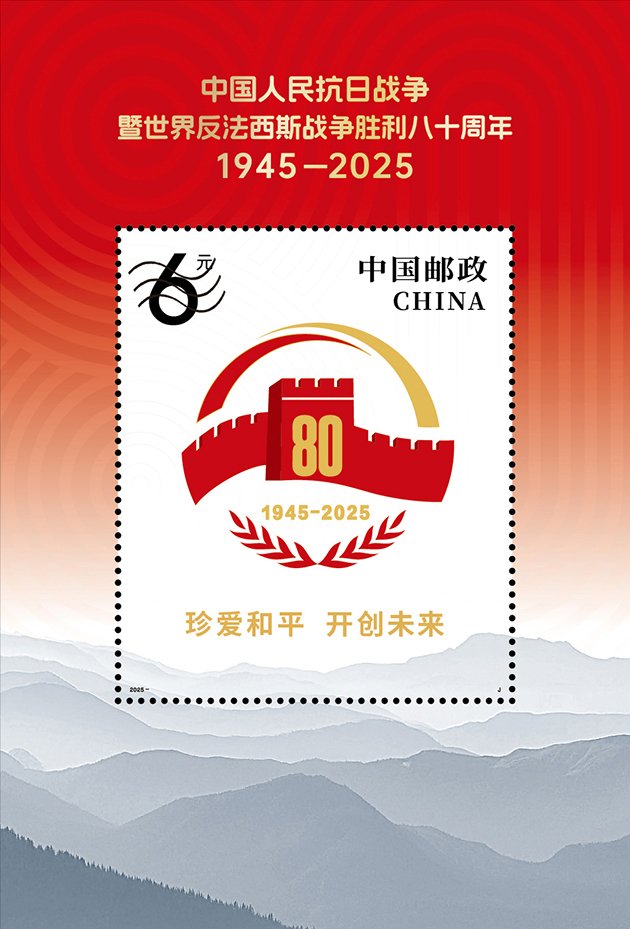
2025‑18 Souvenir‑sheet of Commemorative Stamps|抗战胜利八十周年小型张
小型张使用中国人民抗日战争暨世界反法西斯战争胜利80周年纪念活动标识作为主景,主要表现“珍爱和平、开创未来”。
该套纪念邮票较好地反映了纪念活动主题,弘扬了伟大抗战精神,庄严厚重,更具艺术感染力、历史表现力和视觉冲击力,能够更好展现中国人民14年艰苦卓绝的抗战历程,更好凸显中国共产党的中流砥柱作用和中国抗战的东方主战场地位。
Sellos Conmemorativos: 80.º Aniversario de la Victoria de la Guerra de Resistencia del Pueblo Chino contra la Agresión Japonesa y de la Guerra Mundial Antifascista (2025‑18)
Correos de China emitió un juego de trece sellos conmemorativos y una hoja souvenir 80.º Aniversario de la Victoria de la Guerra de Resistencia del Pueblo Chino contra la Agresión Japonesa y de la Guerra Mundial Antifascista el 3 de septiembre de 2025.
(13‑1) J Levantarse para resistir la agresión japonesa 0,80 CNY
(13‑2) J Ocho heroínas que se ahogaron 0,80 CNY
(13‑3) J Estallido de la guerra de resistencia nacional 1,20 CNY
(13‑4) J Gran victoria de Pingxingguan 1,20 CNY
(13‑5) J Masacre de Nankín 1,20 CNY
(13‑6) J Batalla de Taierzhuang 1,20 CNY
(13‑7) J Ofensiva de los Cien Regimientos 1,20 CNY
(13‑8) J Compañía Liuzhuanglian 1,20 CNY
(13‑9) J Sobre la guerra prolongada 1,20 CNY
(13‑10) J Guerra popular 1,20 CNY
(13‑11) J Fuerza Expedicionaria China 1,20 CNY
(13‑12) J Luchar hombro con hombro 1,20 CNY
(13‑13) J Gran victoria 1,20 CNY
Hoja‑souvenir: 80.º Aniversario de la Victoria de la Guerra de Resistencia del Pueblo Chino contra la Agresión Japonesa y de la Guerra Mundial Antifascista 6,00 CNY
Número de serie: 2025‑18
Dimensiones del sello: 44×33 mm | Perforación:13 grados
Sellos por lámina completa:13 unidades (un juego completo)
Tamaño lámina completa:224×180 mm
Tamaño sello de hoja‑souvenir:50×60 mm
Tamaño exterior hoja‑souvenir:80×118 mm
Perforación hoja‑souvenir:13 grados
Técnica de impresión: Offset
Medidas de seguridad: Papel de seguridad, tinta de seguridad, perforaciones irregulares, código fluorescente
Diseñador: Creación colectiva de Fábrica de Sellos de Beijing Co., Ltd.
Fuente de datos: Museo Histórico del 18‑de‑septiembre, Museo Militar Revolucionario del Pueblo Chino, Salón Conmemorativo de la Gran Victoria de Pingxingguan, Salón Conmemorativo de las Víctimas de la Masacre de Nankín por invasores japoneses, Salón Conmemorativo de la Batalla de Taierzhuang, Departamento de Propaganda del Comité Municipal del PCCh de Yangquan, Departamento de Propaganda del Comité Distrital de Huaiyin (Huai’an), Archivos Centrales, Salón Conmemorativo de la Guerra de Resistencia del Pueblo Chino contra la Agresión Japonesa, Salón Conmemorativo de la Guerra de Minas de Haiyang, Salón Conmemorativo de la Guerra de Resistencia contra Japón del Yunnan Occidental, Oficina de Vivienda y Desarrollo Urbano‑Rural de Gaoyou
Impresor: Fábrica de Sellos de Beijing Co., Ltd. (sellos); Henan Post & Telecom Technology Co., Ltd. (hoja‑souvenir)
Cantidad planificada:6,00 millones de juegos; hoja‑souvenir:5,00 millones de unidades
Valor facial total (sellos + hoja‑souvenir):20,80 CNY
Este conjunto de sellos toma el curso de catorce años de la guerra de resistencia china como hilo principal, pone de relieve las principales campañas y combates, adopta esculturas temáticas de la guerra de resistencia como forma artística principal y utiliza fotografías históricas como fondo creativo. Los sellos del 1 al 13 interpretan el tema “Recordar la historia, honrar a los héroes caídos”.
(13‑1) Levantarse para resistir la agresión japonesa: Primer plano: Monumento del Calendario Roto del Museo Histórico del 18‑de‑septiembre. Fondo: Manifiesto del Comité Central del PCCh del 20 de septiembre de 1931 y el tramo ferroviario de Liutiaohu volado por tropas japonesas.
(13‑2) Ocho heroínas que se ahogaron: Primer plano: escultura Ocho heroínas que se ahogaron del Museo Militar Revolucionario del Pueblo Chino. Fondo: orillas del río Usuhun en Heilongjiang.
(13‑3) Estallido de la guerra de resistencia nacional: Primer plano: leones de piedra del puente Lugou. Fondo: soldados del Ejército 29 que custodiaban el puente Lugou.
(13‑4) Gran victoria de Pingxingguan: Primer plano: escultura temática del salón principal del Salón Conmemorativo de Pingxingguan. Fondo: la 115.ª División del Ejército de la Octava Ruta avanzando hacia Pingxingguan.
(13‑5) Masacre de Nankín: Primer plano: muro conmemorativo con la inscripción “300 000 víctimas” en chino, inglés y japonés. Fondo: ciudad de Nankín destruida e incendiada por tropas japonesas.
(13‑6) Batalla de Taierzhuang: Primer plano: relieve Unirse para resistir la agresión. Fondo: puerta de la ciudad de Taierzhuang después de la batalla.
(13‑7) Ofensiva de los Cien Regimientos: Primer plano: fragmento de la escultura Ofensiva de los Cien Regimientos, Gloria Eterna. Fondo: posición de ametralladora del Ejército de la Octava Ruta en la batalla de Shinaoshan.
(13‑8) Compañía Liuzhuanglian: Primer plano: escultura Pilar del parque conmemorativo de la Compañía Liuzhuanglian del Nuevo Cuarto Ejército. Fondo: monumento a los ochenta y dos mártires y bandera de la compañía Liuzhuanglian.
(13‑9) Sobre la guerra prolongada: Primer plano: Mao Zedong redactando Sobre la guerra prolongada en una cueva‑vivienda de Yan’an. Fondo: facsímil del texto, monte Baota de Yan’an, tropas de caballería del Cuerpo de Guarnición de la Región Fronteriza Shaanxi‑Gansu‑Ningxia.
(13‑10) Guerra popular: Primer plano: escultura Cinco Generales Tigre del salón de la guerra de minas de Haiyang. Fondo: relieve de madres enviando hijos al frente, consignas: “Los buenos hombres toman las armas”, “Resistir Japón y salvar la nación”, “Unidad”.
(13‑11) Fuerza Expedicionaria China: Primer plano: fragmento de escultura Fuerza Expedicionaria China. Fondo: fuerza expedicionaria china en marcha.
(13‑12) Luchar hombro con hombro: Primer plano: escultura Defender la Paz. Fondo: Tigres Voladores, ruta de puente aéreo Hump.
(13‑13) Gran victoria: Primer plano: inscripción de Mao Zedong publicada en el diario Xinhua Daily el 3‑sep‑1945 y escultura Momento de Victoria. Fondo: población de Yan’an celebrando la victoria de la guerra de resistencia.
La hoja‑souvenir adopta el logotipo oficial de los actos conmemorativos del 80.º aniversario como elemento principal, expresando el lema “Valorar la paz y construir el futuro”.
El conjunto refleja adecuadamente el tema del evento conmemorativo y promueve el gran espíritu de la guerra de resistencia contra la agresión japonesa. Es solemne y ponderado, con gran fuerza expresiva artística, histórica y visual. Representa la dura lucha de catorce años del pueblo chino, pone de relieve el papel principal del Partido Comunista de China y la posición de China como frente principal oriental de la guerra mundial antifascista.
طوابع تذكارية: الذكرى الثمانون لانتصار حرب مقاومة الشعب الصيني ضد العدوان الياباني والحرب العالمية المناهضة للفاشية (2025‑18)
أصدر بريد الصين مجموعة مكونة من ثلاثة عشر طابعًا تذكاريًا بالإضافة إلى ورقة تذكارية واحدة «الذكرى الثمانون لانتصار حرب مقاومة الشعب الصيني ضد العدوان الياباني والحرب العالمية المناهضة للفاشية» في 3 سبتمبر عام 2025.
(13‑1) ج: النهوض للمقاومة ضد العدوان الياباني 0.80 يوان صيني
(13‑2) ج: البطلات الثماني اللواتي أغرقن أنفسهن 0.80 يوان صيني
(13‑3) ج: اندلاع حرب المقاومة الشعبية الشاملة 1.20 يوان صيني
(13‑4) ج: النصر الكبير في بينغ شينغ قوان 1.20 يوان صيني
(13‑5) ج: مذبحة نانكين 1.20 يوان صيني
(13‑6) ج: معركة تاير تشوانغ 1.20 يوان صيني
(13‑7) ج: هجوم المائة فوج 1.20 يوان صيني
(13‑8) ج: سرية ليو تشوانغ ليان 1.20 يوان صيني
(13‑9) ج: عن الحرب الطويلة الأمد 1.20 يوان صيني
(13‑10) ج: الحرب الشعبية 1.20 يوان صيني
(13‑11) ج: القوة الاستكشافية الصينية 1.20 يوان صيني
(13‑12) ج: القتال جنباً إلى جنب 1.20 يوان صيني
(13‑13) ج: النصر العظيم 1.20 يوان صيني
ورقة تذكارية: الذكرى الثمانون لانتصار حرب مقاومة الشعب الصيني ضد العدوان الياباني والحرب العالمية المناهضة للفاشية 6.00 يوان صيني
الرقم التسلسلي: 2025‑18
أبعاد الطابع:44×33 ملم | درجة الثقوب:13 درجة
عدد الطوابع في الورقة الكاملة:13 قطعة (مجموعة كاملة واحدة)
أبعاد الورقة الكاملة:224×180 ملم
أبعاد طابع الورقة التذكارية:50×60 ملم
أبعاد خارجية للورقة التذكارية:80×118 ملم
درجة ثقوب الورقة التذكارية:13 درجة
طريقة الطباعة: طباعة أوفست
وسائل الحماية: ورق أمن، حبر أمن، ثقوب غير منتظمة، ترميز فلوري
المصمم: إبداع جماعي لشركة مطابع طوابع بكين المحدودة
مصادر البيانات: متحف التاريخ لحدث 18 سبتمبر، متحف الجيش الثوري للشعب الصيني، متحف ذكرى النصر الكبير في بينغ شينغ قوان، متحف ضحايا مذبحة نانكين على أيدي الغزاة اليابانيين، متحف معركة تاير تشوانغ، دائرة الدعاية للجنة الحزب الشيوعي الصيني في مدينة يانغ قوان، دائرة الدعاية للجنة الحزب في منطقة هواي يين (هواي آن)، الأرشيفات المركزية، متحف حرب مقاومة الشعب الصيني ضد العدوان الياباني، متحف حرب الألغام في هاي يانغ، متحف حرب المقاومة ضد اليابان في يوننان الغربية، مكتب الإسكان والتنمية الحضرية والريفية في مدينة غاو يو
المطبعة: شركة مطابع طوابع بكين المحدودة (للطوابع)؛ شركة هنان لتكنولوجيا البريد والاتصالات (للورقة التذكارية)
الكمية المخطط لها:6 ملايين مجموعة؛ الورقة التذكارية:5 ملايين نسخة
القيمة الاسمية الإجمالية (طوابع + ورقة تذكارية):20.80 يوان صيني
تأخذ مجموعة الطوابع مسار حرب المقاومة الصينية لمدة أربعة عشر عاماً كخط رئيسي، وتركز على المعارك والعمليات القتالية الكبرى، وتستخدم المنحوتات ذات الموضوعات الحربية كشكل فني رئيسي، وتعتمد الصور التاريخية كخلفية للإبداع. الطوابع من رقم 1 إلى 13 تعبر عن الموضوع «تذكر التاريخ وتكريم الشهداء».
(13‑1) النهوض للمقاومة ضد العدوان الياباني: المقدمة: نصب «التقويم المكسور» في متحف 18 سبتمبر. الخلفية: البيان الصادر عن اللجنة المركزية للحزب الشيوعي الصيني بتاريخ 20 سبتمبر 1931، وقطعة سكة حديد ليو تياو هو التي دمرتها القوات اليابانية.
(13‑2) البطلات الثماني اللواتي أغرقن أنفسهن: المقدمة: منحوتة «البطلات الثماني اللواتي أغرقن أنفسهن» في متحف الجيش الثوري للشعب الصيني. الخلفية: ضفاف نهر أوسوهون في مقاطعة هيلونغجيانغ.
(13‑3) اندلاع حرب المقاومة الشعبية الشاملة: المقدمة: تماثيل الأسود الحجرية في جسر لوغو. الخلفية: جنود الفيلق التاسع والعشرون الذين حراسوا جسر لوغو.
(13‑4) النصر الكبير في بينغ شينغ قوان: المقدمة: المنحوتة الرئيسية في قاعة المتحف. الخلفية: الفرقة 115 من جيش الطريق الثامن وهي تتقدم نحو بينغ شينغ قوان.
(13‑5) مذبحة نانكين: المقدمة: جدار تذكاري يحمل نقش «300000 ضحية» باللغات الصينية والإنجليزية واليابانية. الخلفية: مدينة نانكين التي أحرقتها ودمرتها القوات اليابانية.
(13‑6) معركة تاير تشوانغ: المقدمة: نقش بارز «الاتحاد للمقاومة ضد العدوان». الخلفية: بوابة مدينة تاير تشوانغ بعد المعركة.
(13‑7) هجوم المائة فوج: المقدمة: جزء من منحوتة «هجوم المائة فوج، مجد خالد». الخلفية: موقع مدفع رشاش لجيش الطريق الثامن في معركة جبل شى ناو شان.
(13‑8) سرية ليو تشوانغ ليان: المقدمة: منحوتة «العمود» في حديقة تذكارية سرية ليو تشوانغ ليان للجيش الرابع الجديد. الخلفية: نصب تذكاري للشهداء الاثنين والثمانين وعلم سرية ليو تشوانغ ليان.
(13‑9) عن الحرب الطويلة الأمد: المقدمة: ماو تسي تونغ وهو يكتب «عن الحرب الطويلة الأمد» في مسكن كهفي في يان آن. الخلفية: نسخة من النص، جبل باو تا في يان آن، فرسان فيلق الحرس لمنطقة الحدود شانسي‑غانسي‑نينغشيا.
(13‑10) الحرب الشعبية: المقدمة: منحوتة «الجنرالات الخمسة النمور» في متحف حرب الألغام في هاي يانغ. الخلفية: نقش بارز للأمهات يرسلن أبناءهن إلى الجبهة، وشعارات: «الرجال الصالحون يحملون السلاح للجبهة»، «مقاومة اليابان وإنقاذ الأمة»، «الوحدة».
(13‑11) القوة الاستكشافية الصينية: المقدمة: جزء من منحوتة «القوة الاستكشافية الصينية». الخلفية: القوة الاستكشافية الصينية وهي تسير.
(13‑12) القتال جنباً إلى جنب: المقدمة: منحوتة «الدفاع عن السلام». الخلفية: النمور الطائرة، مسار الجسر الجوي هامب.
(13‑13) النصر العظيم: المقدمة: كتابات ماو تسي تونغ التي نشرتها صحيفة «شين هوا ديلي» في 3 سبتمبر 1945، ومنحوتة «لحظة النصر». الخلفية: سكان مدينة يان آن يحتفلون بانتصار حرب المقاومة.
تستخدم الورقة التذكارية شعار الفعاليات التذكارية للذكرى الثمانون كعنصر بصري رئيسي لتعبير عن شعار «تقدير السلام وفتح المستقبل».
تعكس المجموعة بشكل جيد موضوع الفعالية التذكارية وتنشر الروح العظيمة لحرب المقاومة ضد العدوان الياباني. تتميز بالجدية والثقل، وتمتلك قوة فنية وتاريخية وبصرية كبيرة، وتصور نضال الشعب الصيني الذي استمر أربعة عشر عاماً، وتبرز دور الحزب الشيوعي الصيني كعمود فقري، وموقع الصين كجبهة رئيسية شرقية في الحرب العالمية المناهضة للفاشية.
Leave A Comment
You must be logged in to post a comment.