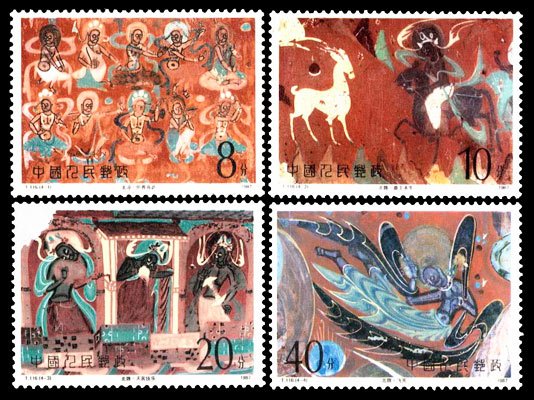
Stamp Title: Dunhuang Murals (1st Set)
Serial number: T116
Values in set: 4
(4-1), North Liang, Budhisattvas, 8 fen, 54*40 mm
(4-2), North wei, Jataka of the Deer King Ruru, 10 fen, 54*40 mm
(4-3), North Wei, Heavenly Musicians, 20 fen, 54*40 mm
(4-4), North Wei, Flying Angels Paradise, 40 fen, 54*40 mm
Date of issue: May 20, 1987
Denomination: 78 fen
Designers: Wu Jiankun, Ren Yu
Size of stamps: 54*40mm
Perforation: 11
Sheet composition: 28 (4*7)
Printing process: Photogravure
Printing House: Beijing Postage Stamp Printing Works
Dunhuang grottoes art is a solid art combining architecture, sculpture, and mural. Although Dunhuang murals only play a role of decoration, and a supplementary role to the sculptures in the Grottoes, but they feature the greatest number, the largest scale, the finest art skills and the richest content, providing very valuable information and material for research on ancient Chinese politics, economy, culture, military, geography, communication, social life, national relationship, religious history, art history, and exchanges with foreign countries and history of cultural exchanges. It is indeed a classic art heritage of great value.
In the 577 grottoes with Mogao grottoes as the principal one, there are more than 45,000 square meters of colorful murals. It was called the biggest museum of fine arts in the world. According research findings, Dunhuang murals can be divided into the following classes:
Buddha Figures: They refer to all kinds of gods and spirits, such as Buddha, Bodhisattva, and Buddha Guards, etc. worshiped by Buddhists. Most of them are painted in the pictures of Teaching Doctrine. In Mogao grottoes alone there are 12,208 figures of Buddha with different expressions and postures in 933 pictures of Teaching Doctrine.
Jingbian Painting: They refer to an art form that employs paintings and literature to make abstract Buddha sutra easy to understand. A drawing that explains abstract sutra is called Bianxiang, and the method of explaining sutra with words and singing is called Bianwen.
Legendary Mural: Its subject maters are traditional Chinese legends, which refer to the contents or subjects of Taoist thought appearing in the Northern Wei Dynasty (386-534). Occurrence of Taoist thoughts in Buddha grottoes reflects the combination of the Buddhist meditative absorption and Taoist Xujing (quiet and calm). It is also the influence of Buddhist thought and art on Chinese culture.
Almsgivers’ Figures: Almsgivers refer to those who believe in Buddhism and finance the building of grottoes. To show their sincere belief in Buddhism and leave fame in the future, they painted themselves, their family members and servants inside the grottoes when building the grottoes.
Decorative Painting: Rich and colorful decorative paintings are mainly used to decorate the construction of grottoes, and desk covers, clothes and containers. The pattern kept changing along with time, revealing outstanding painting skills and rich imagination of the artists. The patterns mainly include sunken panel, rafter, and edge decoration, etc.
Story Painting: To attract more and more people and spread Buddhism with great efforts, it is necessary to transmit the abstract and profound Buddhist sutra to ordinary people in simple words and vivid form. Therefore plenty of story paintings were painted in grottoes, which have exerted an imperceptible influence on people when they saw the murals. The stories are full of rich content and moving plot with strong life atmosphere and great charm.
Except the above-mentioned murals, there are also murals on buildings, containers, flowers and birds, animals, etc. Dunhuang Murals systematically reflect changes and art exchange history between China and western countries in respect of the art style of various periods in arrangement, figure, outline, and color, etc.
T116 敦煌壁画(第一组)
(1) 8分, 北凉·供养菩萨, 1675.502万枚。
(2)10分, 北魏·鹿王本生, 643.552万枚。
(3)20分, 北魏·天宫伎乐, 932.602万枚。
(4)40分, 北魏·飞天, 645.972万枚。
发行日期:1987.5.20。影写版。P11。54mm×40mm。28(4×7)。
设计:吴建坤、任宇。印刷:北京邮票厂。
T116M 敦煌壁画(小型张)
2元, 北魏·萨埵太子舍身饲虎, 329.39万枚。
发行日期:1987.5.20。影写版。P11×11.5。设计:吴建坤、任宇。印刷:北京邮票厂。
小型张规格:130mm×93mm。邮票规格:93mm×78mm。
敦煌壁画指地处甘肃省敦煌县三危山和鸣沙山莫高窟中的壁画。莫高窟开窟造像始于公元4世纪(366年)。这里是古代中西交通、丝绸贸易的必经要冲。自佛教传入中国,佛教文化迅速繁荣发展,这里历经魏晋、南北朝、隋唐、五代、宋元等几个时期的精心营造,成了佛像雕刻、壁画艺术的荟萃之地。
由于敦煌莫高窟壁画产生的年代,正好是印度佛教在中国盛传的时代,壁画集中反映了这一时代的生活内容。其壁画主题几乎全与佛教有关,但这些宗教艺术却能将宗教意境与人们的现实思想感情紧密结合起来,其天堂、宗教人物、经变故事都是有血肉的活的生命艺术。
第一图:《北凉·供养菩萨》。他们或手捧莲衣供养,或因听法而手舞足蹈,或为析义而交头接耳,或陷入沉思,神态各异,无不栩栩如生。
第二图:《北魏·鹿王本生》。讲述的是一个经变故事:鹿王从水中救起溺水人,但此人却恩将仇报,出卖了鹿王,鹿王向前来的国王讲述了经过,国王受到了感动,恶人终有报应。画面十分典雅和谐。
第三图:《北魏·天宫伎乐》。天宫或称作乾洇婆城,是香音神幻化出来的空中楼阁,乐舞便在其中演出。
第四图:《北魏·飞天》。飞天为佛教八部天中的乾洇婆,又名香音神,是散放香气和音乐舞蹈的天神。画面上飞天体态轻盈,裙裾、飘带飞扬,与其神灵境界十分和谐。
2026-1 Bing Wu Year (Year of the Horse) (2-1), Galloping for Grand Endeavors, 120 fen,…
[gallery columns="4" size="medium" ids="39492,39493,39494,39495"] Serial number: 2026-4 Values in set: 4 (4-1), Six‑Faced Self‑Seal -…
[gallery type="rectangular" ids="39468,39469,39470,39471,39472,39473,39474,39475"] A set of 4 stamps with face value at 2.50, 4.00, 4.50…
[gallery type="rectangular" columns="2" size="medium" ids="39364,39365"] Serial number: 2025-1 Values in set: 2 Date of issue:…
[gallery type="columns" columns="2" size="medium" ids="39285,39286,39287,39288"] Postage Stamp Title: The Investiture of The Gods (1) Serial…
[gallery type="rectangular" ids="39242,39237,39238,39239"] Postage Stamp Title: Chinese Seal Engraving (2) Serial number: 2024-3 Values in…