
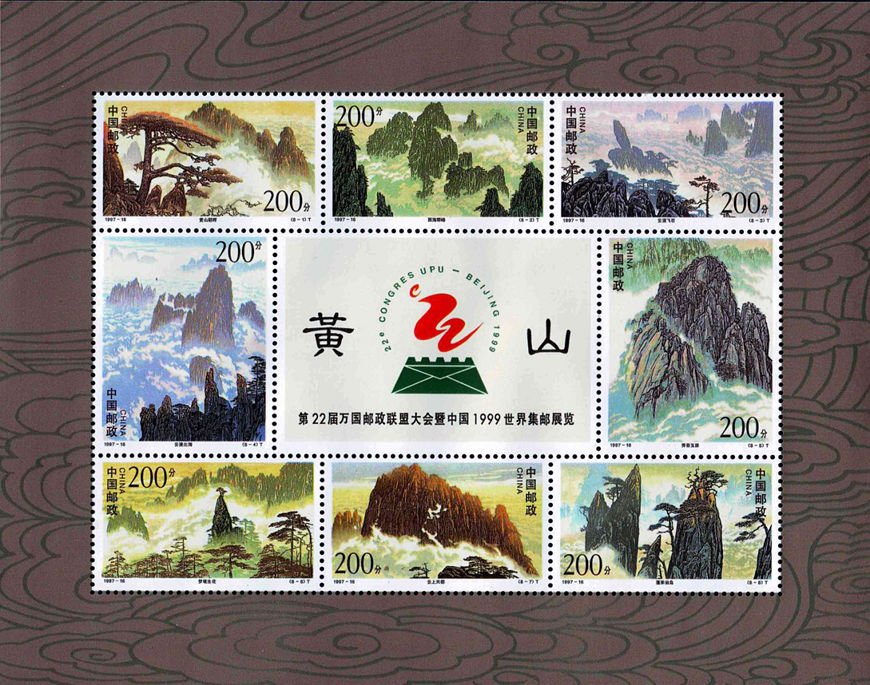
1997-16, Huangshan Mountains《黄山》
Stamp Title: Huangshan Mountains
Scott No: 2805
Serial number: 1997-16
Values in set: 8
(8-1), Mount Huangshan at Sunrise, 200 fen, 50*30mm
(8-2), Xihai Peaks, 200 fen, 50*30mm
(8-3), Flying Rock on Gushing Clouds, 200 fen, 50*30mm
(8-4), Beihai in Drifting Clouds, 200 fen, 40*50mm
(8-5), Yuping Peak, 200 fen, 40*50mm
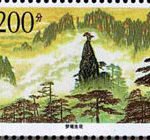
(8-6), Mystical Stone, 200 fen, 50*30mm
(8-7), Tiandu Peak over Clouds, 200 fen, 50*30mm
(8-8), A Fabled Abode of Immortals, 200 fen, 50*30mm
Date of issue: October 20,1997
Designers: Shi Sougling
Size:
50*30mm for Value 1,2,3,6,7,8
40*50mm for Value 4,5
Size of sheetlet: 190 * 150 mm
(1-1), MOUNT HUANGSHAN, 1600 fen, 190¡Á150mm
Perforation: 11.5
Sheet composition: 8
Printing process: gravure
Printing House: Beijing Postage Stamp Printing Works
Mt. Huangshan is located in the southern part of Anhui Province at the juncture of Shexian, Yixian, Taiping and Xiuning counties. It was called Mt. Yishan or Mt. Beiyishan in ancient times. A fable goes that Emperor Huangdi once lived here to cultivate personality and to concoct pills of immortality, it was therefore named Mt. Huangshan in the sixth year of Emperor Tianbao of the Tang Dynasty.
Mt. Huangshan seems to possess the best features of other famous mountains – the grandeur of Mt. Taishan, the elegance of the Wuyi Mountains, the steepness of Mt. Huashan and the magnificence of Mt. Hengshan. And Mt. Huangshan also has scenic spots which can match up to the heavenly waterfalls of Mt. Lushan, the endless peaks of Mt. Emei and the picturesque rocks of the Yandang Mountains. The ancient people had a saying that “all famous natural sceneries under the heaven are right here in Mt. Huangshan”. Xu Xiake, a renowned traveller of the Ming Dynasty, wrote in his “Travel Notes on Mt. Huangshan: “After scaling Mt. Huangshan, one will no longer have the desire to climb other mountains, and travel will come to an end.”
The scenic zones of Mt. Huangshan covers an area of about 154 square kilometres, including 72 peaks such as the Lianhua Feng (Lotus Flower Peak), 24 brooks such as the Taohua Xi (Peach Flower Brook), 12 caves and eight rocks. People often summarize the beautiful scenery of Mt. Huangshan into “four unique features” – legendary pine trees, strange-shaped rocks, sea of clouds and hot springs.
Pine trees on Mt. Huangshan grow coniferous and thick yet short leaves, curved trunks and coiled branches, their tops are flat, and they are luxuriantly green. The Guest-welcoming Pine in front of the Yuping (Jade Screen) Tower and the Phoenix Pine in front of the Haixin Pavilion are the most well known. Vivid they are, some rocks on Mt. Huangshan look like humans while some others are in the shape of particular objects, such as the “Golden Rooster Crowing at the Gate to Heaven” in front of the Banshan Temple and “An Immortal Dries Booth” in the Xihai. Intangible and changing, there are seas of clouds all the year round at Mt. Huangshan. Sometimes they are under the morning shine, and sometimes they are changing rapidly. The mountain and natural scenery give a sense of misty and changing beauty to visitors. Hot springs at Mt. Huangshan are also called “broiling springs” because water temperature remains a constant 42 degrees centigrade all the year round. Water is crystal and sweet, suitable both for bathing and drinking.
“Spring comes in April and there is no winter in the year.” Mt. Huangshan, with ideal climate, beautiful and imposing scenery, is worth climbing. Mt. Huangshan is one of the most famous scenic spots in China, and is also a well known tourist attraction in the world.
The stamps on Mt. Huangshan were issued to celebrate the convening of the 22nd Congress of the International Postal Union and the 1999 China International Philatelic Exhibition.
-

- (8-1), Mount Huangshan at Sunrise, 200 fen, 50*30mm

-
- (8-2), Xihai Peaks, 200 fen, 50*30mm
-
- (8-3), Flying Rock on Gushing Clouds, 200 fen, 50*30mm
-
- (8-4), Beihai in Drifting Clouds, 200 fen, 40*50mm
-
- (8-5), Yuping Peak, 200 fen, 40*50mm

-
- (8-6), Mystical Stone, 200 fen, 50*30mm
-
- (8-7), Tiandu Peak over Clouds, 200 fen, 50*30mm

-
- (8-8), A Fabled Abode of Immortals, 200 fen, 50*30mm

1997年小全张《黄山》
国家邮政局1997年10月20日发行《黄山》小全张1枚。
(8-1)T 黄山朝晖 200分
(8-2)T 西海群峰 200分
(8-3)T 云涌飞石 200分
(8-4)T 云漫北海 200分
(8-5)T 秀吞玉屏 200分
(8-6)T 梦笔生花 200分
(8-7)T 云上天都 200分
(8-8)T 蓬莱仙岛 200分
志号名称:1997-16T
版别:影写
全套面值:16.00元
邮票规格:8-1、8-2、8-3、8-6、8-7、8-8为50×30mm;
8-4、8-5为40×50mm
齿孔度数:11.5 度
发行量:2621.1万枚
售价:16元
设计者:师松龄
印制机构:北京邮票厂
黄山屹立在中国安徽省南部(北纬30度1分,东经118度1分),盘垣于歙、黟、太平、休宁四县之间,方圆250平方公里,精华部份154平方公里。黄山原称作黟山,因传说轩辕皇帝曾在此修身炼丹,唐天宝六年(公元747年)改名。黄山不仅以奇伟俏丽、灵秀多姿著称于世,还是一座资源丰富、生态完整、具有重要科学和生态环境价值的国家级风景名胜区,属世界文化与自然遗产,已被列入《世界遗产名录》。黄山现已成为中国名山之代表,素有“五岳归来不看山,黄山归来不看岳”、“天下第一奇山”之称,并与长江、长城、黄河并称为中华民族的象征之一。
黄山为群山构造,“奇松、怪石、云海、温泉”被称为“黄山四绝”,神奇的冬景和壮美的日出,更让游客流连忘返。山中有名可数的就有36大峰、36小峰,他们或崔嵬雄浑、或俊俏秀丽,布局错落有致、巧然天成。莲花峰、光明顶、天都峰为黄山三大主峰,海拔高度均在1800米以上,并以三大主峰为中心向四周铺展,跌落为深壑幽谷,隆起成峰峦峭壁,呈现出典型的峰林地貌。“峰奇石奇松更奇,云飞水飞山亦飞”,遍布峰壑的黄山松,破石而生,盘结于危岩峭壁之上,挺立余风牙决壑之中,或雄壮挺拔,或婀娜多姿,显示出顽强的生命力。黄山无时不松,奇特的古松,难以胜数。最著名者有迎客松、卧龙松、探海松、黑虎松等30余株。多少年来,它们抵御风吹雨打,霜剑冰刀,吸取岩石中的点滴水分和营养,迎着阳光稳稳地屹立于峰崖之上。而黄山云流动于千峰万壑之间,或成涛涛云海,浩瀚无际,或与朝霞、落日相映,色彩斑斓,壮美瑰丽。
黄山温泉,古称“灵泉”、“汤泉”、“朱砂泉”,水质清澈,可饮可浴,是黄山一绝。黄山是长江与钱塘江两大水系的分水岭。特殊的地理位置,构成36条大峡谷、形成36源,汇流24溪。山水迸泻,形成飞瀑,悬垂如练,溅珠喷玉。“山中一夜雨,处处挂飞泉”,瀑布中著名者有“人字瀑”、“百丈泉”、和“九龙瀑”。
由于黄山花岗岩体垂直节理十分发育,断裂和裂隙纵横交错,形成瑰丽多姿的花岗岩洞穴与孔道,使之重岭峡谷,关口处处。更有历代丰厚的文化积淀,摩崖石刻等名胜古迹200多处。加上日出、日落、云雾、松涛、佛光、秋色、物松、冰挂等自然奇观,幽谷泉鸣,鸟语花香,整个景区犹如一幅幅立体的壮丽画卷。
黄山是美的综合体,是天地造化的宠儿。随便一处,或松或石、或云海清泉,无一不美,无处不奇,置身其间,使人似觉得到了天上人间,不得不感叹大自然的神奇力量。
1982年黄山被国务院列为首批国家级重点风景名胜区,1986年经评选列入中国十大风景名胜区,1990年被联合国教科文组织列入“世界遗产”名录。此后,黄山又相继被评选为国家级“卫生山”、“安全山”,1998年被建设部、国家旅游局等部门确定为全国首批十个文明景区之首。
Leave A Comment
You must be logged in to post a comment.