
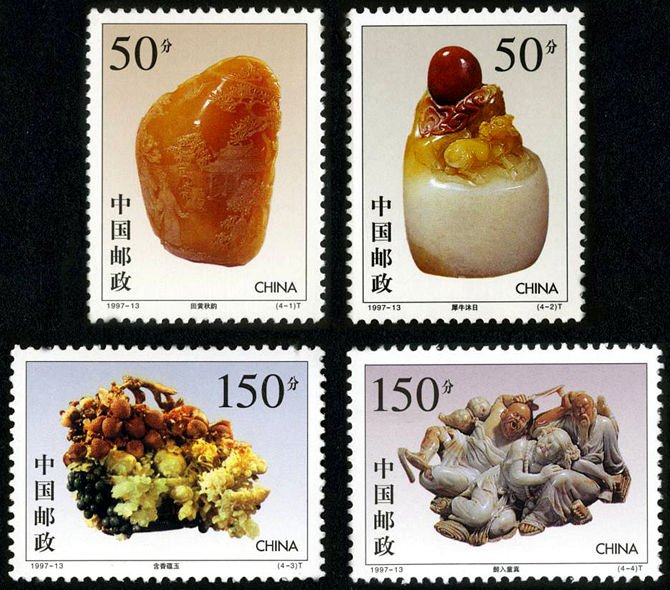
1997-13, Stone Carving of Shoushan《寿山石雕》
Stamp Title:Stone Carving of Shoushan
Serial number: 1997-13
Values in set: 4
(4-1), Rhythm of Autumn, 50 fen, 30*40mm
(4-2), Rhinoceros under Sunshine, 50 fen, 30*40mm
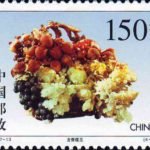
(4-3), Jade’s Fragrance, 150 fen, 40*30mm
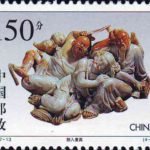
(4-4), Drunken Joy, 150 fen, 40*30mm
Date of issue: August 17,1997
Designers: Ren Guoen; Ke Yongsheng
Size:
30*40mm for Value 1 and 2
40*30mm for Value 3 and 4
Size of the S/S stamp: 60*60mm
Size of S/S: 97*97mm
Perforation: 12
Sheet composition: 50
Printing process: offset
Shoushan stone, produced in Shoushan Township in the northern suburb of Fuzhou City, is one of China’s three most famous stones. The stones are known for their fine texture, multicolours and carveability. There is an old saying about the legendary Nuwa repairing the heaven with stones. Nuwa hid the remnant coloured stones in the Shoushan Mountain, which later became the Shoushan Stones. According to another legend, in the ancient times, a five-coloured phoenix stopped at Shoushan Mountain; wherever she went, lardite was produced, which was smooth and greasy. The eggs that the phoenix laid became Shoushan stones.
The Shoushan stones are flawless beauties. There are more than 100 kinds of Shoushan stones which are classified as Tiandeng, Shuikeng and Shankeng. The art of Shoushan stone carving dated back to 1500 years ago. The carving techniques vary. Some are simple and solid, and some are small and exquisite. Besides seals the Shoushan stones are carved into figures, animals, ancient holy animals, flowers and fruits, fish and insects, and mountain and river. The craftsmen of different dynasties created many masterpieces which had been passed down from generation to generation. The Qianlong Chain Seals, regarded as a precious treasure, was carved out from a whole piece of Tianhuang jade into two square seals and one oval seal, which were linked by three chains. The chain seals were passed sown from Emperor Qianlong to emperors Jiaqing, Daoguang, Xianfeng, Tongzhi, Guangxu and Xuantong. When the last emperor Pu Yi was driven out of the Imperial Palace, he hid the seals in his suitcase. After being reeducated. Pu Yi donated this precious antique to the State. So the Qianlong Chain Seals were brought back to the Palace Museum.
1997年特种邮票《寿山石雕》
国家邮政局1997年8月17日发行《寿山石雕》特种邮票1套4枚,小型张1枚。
(4-1)T 田黄秋韵 50 分 3171.75万枚
(4-2)T 犀牛沐日 50 分 3171.75万枚
(4-3)T 含香蕴玉 150 分 2541.75万枚
(4-4)T 醉入童真 150 分 2541.75万枚
小型张 乾隆链章 800 分 2120.56万枚
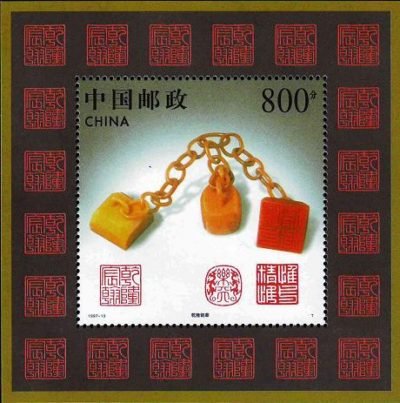
1997-13, Stone Carving of Shoushan《寿山石雕》(1-1), Qianlong’s Chain Seals, 800 fen, 97*97mm/ 60*60mm
志号名称:1997-13T
整版枚数:50枚
版别:胶印
齿孔度数:12度
邮票规格:30×40毫米
小型张邮票规格:60×60毫米
小型张外形规格:97×97 毫米
设计者:任国恩、柯永生
印制机构:河南省邮电印刷厂
寿山石雕,汉族民间雕刻艺术之一。寿山石雕技法丰富多样,精湛圆熟,又在发展过程中广纳博采,融合了中国画和各种民间工艺的雕刻技艺与艺术精华。其技法主要包括圆雕、印钮雕、薄意雕、镂空雕、浅浮雕、高浮雕、镶嵌雕、链雕、篆刻和微雕等。寿山石雕作品题材广泛,有人物、动物、山水、花鸟等品类。由于这些原因,寿山石雕的社会影响面极广,具有“上伴帝王将相,中及文人雅士,下亲庶民百姓”的艺术魅力,深受国内外鉴赏家与收藏家的好评。寿山石雕在中国传统玉石文化中占有突出地位,相关雕刻品已成为高雅、精美、凝重和睿智的象征。寿山石雕追求既雕既琢的艺术效果,提倡返璞归真,故以“相石”为重要环节,讲究利用石形石色,巧施技艺,以达到“天工合一”的境界。
-

- (4-1), Rhythm of Autumn, 50 fen, 30*40mm
-
- (4-2), Rhinoceros under Sunshine, 50 fen, 30*40mm
-
- (4-3), Jade’s Fragrance, 150 fen, 40*30mm
-
- (4-4), Drunken Joy, 150 fen, 40*30mm
寿山石雕,历史悠久。早在南朝、明清两代,精品多为宫廷收存。寿山石雕技术精湛,相石构思,因材施艺,巧取天然,善于发挥园雕、浮雕、薄意雕、镂空雕等多种艺术技巧,达到出神入化的艺术境界。它是立足于中华沃土渊源之上的艺术奇葩,是中国传统艺术的重要组成部分。
1997年8月17日,为了展示中国民间雕刻艺术成就,邮电部发行了《寿山石雕》特种邮票,全套4枚。
Leave A Comment
You must be logged in to post a comment.