
-
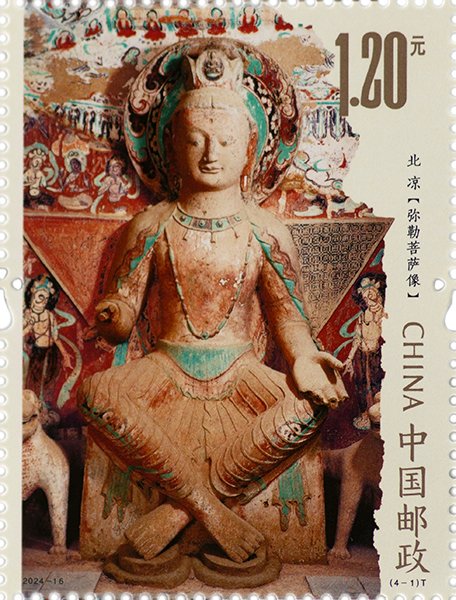
- 2024‑16 China Special Stamp Mogao Grottoes (II) (4‑1) Maitreya Bodhisattva, Northern Liang Dynasty, Dunhuang clay sculpture
-

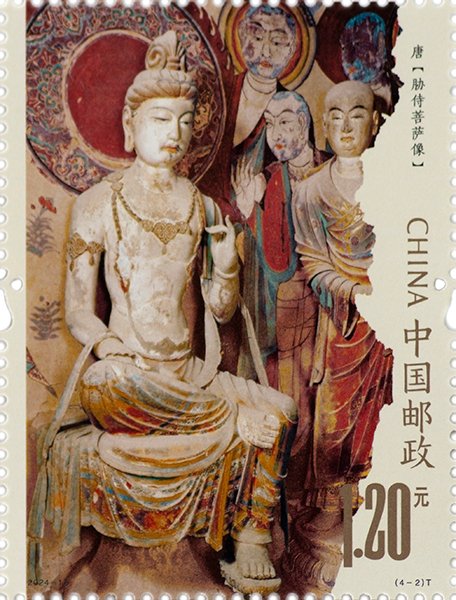
- 2024‑16 China Special Stamp Mogao Grottoes (II) (4‑2) Attendant Bodhisattva, Tang Dynasty, Dunhuang painted clay sculpture
-
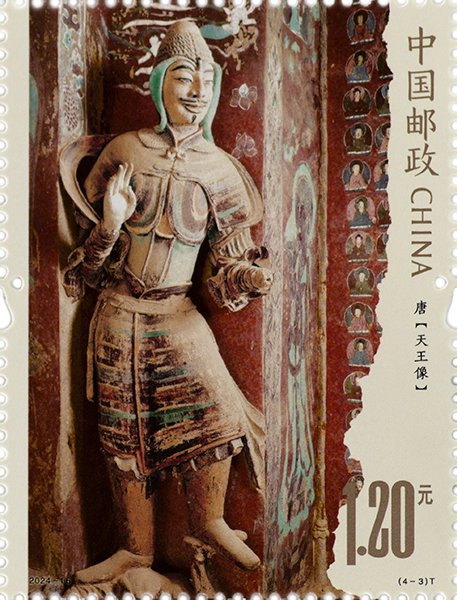
- 2024‑16 China Special Stamp Mogao Grottoes (II) (4‑3) Heavenly King, Tang Dynasty, Dunhuang grotto sculpture
-
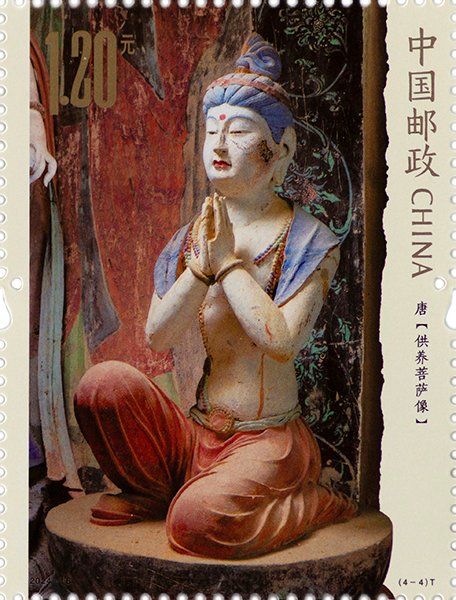
- 2024‑16 China Special Stamp Mogao Grottoes (II) (4‑4) Donor Bodhisattva, Tang Dynasty, Dunhuang Buddhist art
Postage Stamp Title: Mogao Caves (Mogao Grottoes of Dunhuang) (2)
Serial number: 2024-16
Values in set: 4
Date of issue: August 3rd, 2024
Denomination: Total face value 10.80 yuan
Designer: Xia Jingqiu, Ma Lihang
Size of stamps: 38 * 50 mm
Perforation: 13
Sheet composition: 12
Sheet Size: 190 * 230 mm
Size of S/S: 150 * 84 mm
Size of S/S stamp: 60 * 50 mm
S/S Perforation: 13.5
Printing process: Offset
Printing House: Beijing Postage Stamp Printing Works
China Post is scheduled to issue a set of 4 special stamps and 1 souvenir sheet themed Mogao Grottoes (II) on August 3, 2024. The stamps feature designs entitled Maitreya Bodhisattva (Northern Liang Dynasty), Attendant Bodhisattva (Tang Dynasty), Heavenly King (Tang Dynasty), and Donor Bodhisattva (Tang Dynasty), while the souvenir sheet depicts Sakyamuni Buddha Triptych (Sui Dynasty). The planned circulation is 6.2 million sets of stamps and 5.3 million souvenir sheets.
Dunhuang, known as the “key gateway” of the ancient Silk Road, is a mysterious and brilliant cultural pearl on the Hexi Corridor. Commonly referred to as the “Thousand Buddha Grottoes”, the Mogao Grottoes are located on the eastern foot of Mingsha Mountain and the western bank of Dangquan River, 25 kilometers southeast of Dunhuang City, Gansu Province. As one of China’s Four Great Grottoes, the Mogao Grottoes were first excavated in 366 AD, boasting a history of over 1,600 years. In 1987, they were listed as one of China’s first World Cultural Heritage sites. Today, they stand as the world’s largest and best-preserved Buddhist art heritage, with the longest historical continuity, richest content, and finest artistic craftsmanship.
In terms of visual style and color scheme, the design of this stamp set maintains a high degree of consistency with the first Mogao Grottoes stamp series. Adopting modern design composition to convey traditional Chinese cultural essence, the stamps vividly present the simple, profound, magnificent, and elegant textures and forms of the sculptures. The souvenir sheet focuses on showcasing the architectural characteristics of the three-niche palace cave, highlighting the profound historical and cultural charm of the Mogao Grottoes. In terms of design language, decorative patterns are abandoned in pursuit of a minimalist modern aesthetic. Breaking free from frame constraints, the visual scope of the stamps is expanded and enhanced. The natural shapes formed by wear and restoration are ingeniously utilized to create negative space in the images—this indirect representation of incomplete parts also depicts the hardships and vicissitudes the Mogao Grottoes have endured. The Mogao Grottoes (II) stamps are printed using high-precision offset lithography, with full-color border decorations. Under fluorescent light, the exquisite murals are vividly reproduced, creating an immersive experience as if one were inside the grottoes. The souvenir sheet uses fluorescent ink, displaying a gradient halo effect under ultraviolet light, which better reflects the deep and intricate visual impression of the cave interiors.
This set of stamps was designed by Xia Jingqiu, the souvenir sheet by Ma Lihang, and edited by Wang Jing. It is printed by Beijing Stamp Printing Co., Ltd. using offset lithography technology.
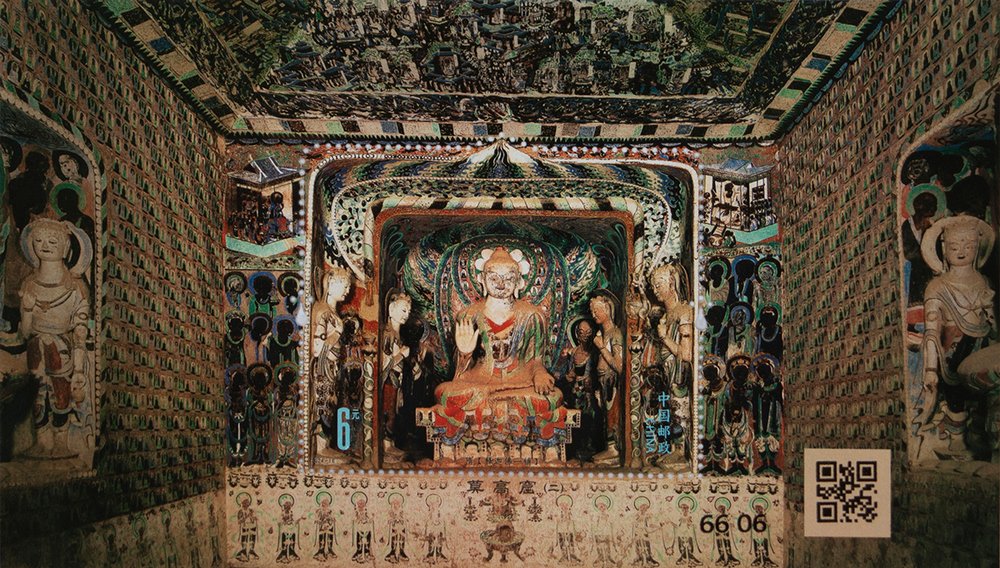
2024‑16 China Special Stamp Mogao Grottoes (II) souvenir sheet, Sakyamuni Buddha triptych of Sui Dynasty, Dunhuang cave art
2024-16《莫高窟(二)》特种邮票
志号:2024-16
全套枚数:4枚
发行日期:2024年8月3日
全套总面值:10.80元
设计者:夏竞秋、马立航
邮票规格:38×50毫米
齿孔度数:13度
整张枚数:12枚
整张规格:190×230毫米
小型张规格:150×84毫米
小型张内邮票规格:60×50毫米
小型张齿孔度数:13.5度
版别:胶印
印制厂:北京邮票厂有限公司
中国邮政定于2024年8月3日发行《莫高窟(二)》特种邮票1套4枚,小型张1枚。邮票图案名称分别为:北凉·弥勒菩萨像、唐·胁侍菩萨像、唐·天王像、唐·供养菩萨像;小型张图案为隋·释迦佛一铺。计划发行量:套票620万套,小型张530万枚。
敦煌是古丝绸之路的咽喉锁钥,河西走廊上璀璨的文化明珠。莫高窟俗称千佛洞,坐落于甘肃敦煌市东南25公里鸣沙山东麓、宕泉河西岸崖壁。作为中国四大石窟之一,莫高窟始凿于公元366年,距今1600余年。1987年列入中国首批世界文化遗产,是现存世界规模最大、保存最完好、历史延续最长、内容最丰富、艺术最精湛的佛教艺术遗存。
本套邮票视觉风格与色彩体系,和第一组《莫高窟》邮票保持高度统一。以现代构图诠释中华传统文化内核,生动展现彩塑古朴厚重、恢宏典雅的质感与形态。小型张重点表现三龛殿堂窟建筑特征,凸显莫高窟厚重的历史文化韵味。设计摒弃繁复装饰纹样,走简约现代美学,打破边框束缚拓展视觉空间。巧妙利用风化、修复形成的自然残损形态营造画面留白,借残缺表达洞窟历经的沧桑岁月。邮票采用高精度胶版印刷,边饰全彩工艺;紫外荧光灯下,精美壁画显现,带来身临其境的洞窟沉浸感。小型张采用荧光油墨,紫外光下呈现渐变光晕,还原洞窟幽深繁复的视觉效果。
本套邮票由夏竞秋设计,小型张由马立航设计,责任编辑王静,北京邮票厂胶版印制。
Sello Especial: Grutas de Mogao (Dunhuang) (II)
Número de serie: 2024-16
Cantidad en el conjunto: 4
Fecha de emisión: 3 de agosto de 2024
Valor facial total: 10,80 yuanes
Diseñador: Xia Jingqiu, Ma Lihang
Tamaño del sello: 38 * 50 mm
Perforación: 13
Cantidad por hoja: 12
Tamaño de hoja: 190 * 230 mm
Tamaño de hoja pequeña: 150 * 84 mm
Tamaño del sello en hoja pequeña: 60 * 50 mm
Perforación hoja pequeña: 13,5
Proceso de impresión: Offset
Imprenta: Fábrica de Sellos de Beijing Co., Ltd.
Correos de China emitió el 3 de agosto de 2024 un conjunto de 4 sellos especiales y una hoja pequeña dedicado a las Grutas de Mogao (II). Los diseños corresponden a Bodhisattva Maitreya (Dinastía Beiliang), Bodhisattva acompañante (Dinastía Tang), Rey Celestial (Dinastía Tang) y Bodhisattva oferente (Dinastía Tang). La hoja pequeña representa el conjunto de Buda Shakyamuni (Dinastía Sui). La tirada planificada es de 6,2 millones de conjuntos y 5,3 millones de hojas pequeñas.
Dunhuang, la puerta clave de la antigua Ruta de la Seda, es una joya cultural brillante en el corredor de Hexi. Conocidas como las Cuevas de los Mil Budas, las Grutas de Mogao se encuentran a 25 km al sureste de la ciudad de Dunhuang, pie de la montaña Mingsha. Una de las cuatro grandes grutas de China, excavadas por primera vez en el año 366 d.C., con más de 1600 años de historia. En 1987 fue declarada Patrimonio de la Humanidad. Es el legado budista más grande y mejor conservado del mundo, con continuidad histórica prolongada, contenido rico y excelente artesanía.
En estilo visual y paleta de colores, esta serie mantiene coherencia con la primera emisión de sellos de las Grutas de Mogao. Usa composición moderna para transmitir la esencia cultural china, mostrando la textura y forma sencilla, majestuosa y elegante de las esculturas. La hoja pequeña destaca las características arquitectónicas de la cueva de tres nichos, mostrando el encanto histórico-cultural de Mogao. El diseño elimina ornamentos excesivos, adopta una estética moderna minimalista y rompe los límites del marco para ampliar el campo visual. Aprovecha hábilmente las formas naturales del desgaste y restauración para crear espacios vacíos; esta representación indirecta de las partes incompletas refleja las vicisitudes sufridas por las grutas. La serie se imprime en offset de alta precisión con decoraciones a todo color en los bordes. Bajo luz ultravioleta, los murales se revelan, creando una sensación inmersiva dentro de la cueva. La hoja pequeña utiliza tinta fluorescente, mostrando un halo degradado bajo luz UV que recrea la profundidad interior de la gruta.
Los sellos fueron diseñados por Xia Jingqiu, la hoja pequeña por Ma Lihang, con edición de Wang Jing. Impresos por la Fábrica de Sellos de Beijing mediante offset.
طوابع خاصة: كهوف موغاو (دونهوانغ) (الجزء الثاني)
رقم السلسلة: 2024-16
عدد الطوابع في المجموعة: 4
تاريخ الإصدار: 3 أغسطس 2024
القيمة الاسمية للمجموعة الكاملة: 10.80 يوان صيني
المصمم: شيا جينغ تشيو ، ما لي هانغ
أبعاد الطابع: 38 * 50 ملم
درجة الثقوب: 13
عدد الطوابع في الورقة الكاملة: 12
أبعاد الورقة الكاملة: 190 * 230 ملم
أبعاد الورقة الصغيرة: 150 * 84 ملم
أبعاد منطقة التصميم في الورقة الصغيرة: 60 * 50 ملم
درجة الثقوب للورقة الصغيرة: 13.5
طريقة الطباعة: الطباعة الأوفست
مصنع الطباعة: شركة مصنع طوابع بكين المحدودة
أصدر بريد الصين في 3 أغسطس 2024 مجموعة مكونة من 4 طوابع خاصة وورقة صغيرة بعنوان «كهوف موغاو (الجزء الثاني)». تصاميم الطوابع: بوذا ميتريا (أسرة بي ليانغ)، بوديساتفا المرافق (أسرة تانغ)، الملك السماوي (أسرة تانغ)، بوديساتفا المقدم للقرابين (أسرة تانغ). الورقة الصغيرة تعرض مجموعة بوذا شاكيموني (أسرة سوي). العدد المخطط للإصدار: 6.2 مليون مجموعة، و5.3 مليون ورقة صغيرة.
دونهوانغ هي بوابة الطريق الحريري القديم، وهي لؤلؤة ثقافية متلألئة في ممر هسي. تُعرف كهوف موغاو باسم «كهوف الألف بوذا»، وتقع على بعد 25 كيلومتر جنوب شرق مدينة دونهوانغ، عند سفح جبل مينغشا. وهي أحد أربعة مجموعات كهوف كبيرة في الصين، حُفرت لأول مرة في عام 366 ميلادي، ولها تاريخ يمتد لأكثر من 1600 سنة. في عام 1987 أُدرجت ضمن مواقع التراث الثقافي العالمي. وهي أكبر تراث فني بوذي محفوظ في العالم، تتميز بالاستمرارية التاريخية الطويلة، والمحتوى الغني، والحرفية الفنية الرائعة.
يحافظ تصميم هذه الطوابع على تناسق تام من ناحية الأسلوب البصري والألوان مع الإصدار الأول لطوابع كهوف موغاو. يستخدم التصميم التكوين العصري لنقل جوهر الثقافة الصينية، ويُظهر ملمس وأشكال التماثيل البسيطة والمهيبة والأنيقة. تركز الورقة الصغيرة على الخصائص المعمارية للكهف ذي الثلاثة محاريب، لتبرز السحر التاريخي والثقافي العميق لكهوف موغاو. يتخلى التصميم عن الزخارف الزائدة ويتبع الجمالية العصرية البسيطة، ويكسر حدود الإطار لتوسيع المجال البصري. يستغل ببراعة الأشكال الطبيعية الناتجة عن التآكل والترميم لخلق مساحات فارغة في الصور؛ وهذا التمثيل غير المباشر للأجزاء التالفة يعكس الصعوبات والتقلبات التي مرت بها الكهوف. تُطبع المجموعة بطريقة الأوفست عالية الدقة مع زخارف ملونة كاملة على الحواف. تحت ضوء الأشعة فوق البنفسجية، تظهر لوحات الجدران بوضوح لتمنح المشاهد إحساسًا بالوجود داخل الكهف. تستخدم الورقة الصغيرة حبرًا فلورسنتيًا، فتظهر هالة متدرجة تحت ضوء الأشعة فوق البنفسجية لتجسد عمق الكهوف.
صمم الطوابع شيا جينغ تشيو، وصمم الورقة الصغيرة ما لي هانغ، والتحرير لوانغ جينغ. تمت الطباعة في شركة مصنع طوابع بكين بطريقة الأوفست.
Leave A Comment
You must be logged in to post a comment.