
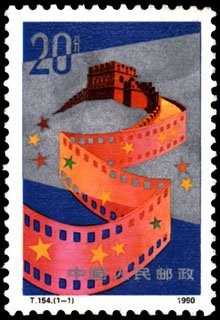
T154, Chinese Films《中国电影》
Stamp Title:Chinese Films
Serial number: T154
Values in set: 1
Date of issue: September 21, 1990
Denomination: 20 fen
Designers: Lu Tianjiao
Size of stamps: 27*40mm
Perforation: 11
Sheet composition: 50 (10*5)
Printing process: Photogravure
Printing House: Beijing Postage Stamp Printing Works
China’s major annual national awards include the” Golden Rooster Film Awards” sponsored by the China Film Association, the “Hundred Flowers Awards” of the magazine” Popular Cinema” and the” Outstanding Film Awards” given by the Ministry of Radio Film and Television.
The annual” Golden Rooster Film Awards,” named for the Year of the Rooster, were initiated in 1981. With a jury of more than 20 prominent film artists, critics and film artists, critics and film historians, they cover a wide range of film categories and performances and are designed to promote creativity, film research and criticism. After a period of suspension during the” cultural revolution,” the” Hundred Flowers Awards” were resumed in 1980, having begun in 1962. These awards are usually limited to seven categories; for three best films, best leading actor and actress and best supporting actor and actress. Winners are selected by a viewers’ poll. To encourage and promote the film industry, the government makes its own awards in several categories. Issued by the Ministry of Culture before 1986 and by the Ministry of Radio, Film and Television since that time, the awards were resumed in 1980 after a suspension of more than 20 years. The awards were first instituted in 1957.
In China, the first generation of directors usually refers to Chinese opera directors like Zheng Zhengqiu and Cai Chusheng who turned to the screen in the 1920s at the dawn of the film making age. They produced silent films of Chinese operas. The opera films gave way to modern drama films in the ’30s and ’40s, made by second generation artists as Yuan Muzhi and Tang Xiaodan, all former stage directors. The third generation, which includes Ling Zifeng, Xie Tian and Xie Jin, refers to a group of directors who emerged in the 1950s after the founding of New China. The fourth generation includes graduates like Wu Yigong and Wu Tianming, of the China Film Academy and other film schools. These older directors are basically followers of traditional techniques of expression taught by Soviet experts in the 1950s. But the” Fifth Generation” has drawn much more on modern Western literature and Western schools of films since their horizons were broadened through film exchanges with foreign countries after the” Cultural Revolution.” Their films, like Chen Kaige’s ” Yellow Earth” and” The King of Children”, Zhang Junzhao’s “One and Eight, Tian Zhuang zhuang’s” The Horse Thief,” Zhang Yimou’s” Red Sorghum” and Woo Ziniu’s” Evening Bell, ” usually stress message rather than plot, and use fast -paced imagery rather than dialogue to convey their messages.
If we talk about Chinese movies here, we must pay enough attention to the film industry in Hangkong, which can be called the Eastern Hollywood.
T154 中国电影
20分,中国电影,3691.15万枚。
发行日期:1990.9.21。影写版。P11。27mm×40mm。50(10×5)。
设计:卢天骄。印刷:北京邮票厂。
1905年,北京丰禄照相馆摄制了京剧舞台纪录片《定军山》,揭开了中国人摄制影片的序幕.
电影在中国首次放映 是在电影发明后的第二年(1896)。 1905年中国人自己首次拍电影。1990年是中国电影诞生85周年,为此邮电部发行了这套特种纪念邮票。
本套邮票共1枚,题名为“中国电影”。画面由对比鲜明的颜色构成,将电影胶片画成尤如长城城墙一般,它意味着电影事业和中国民族传统文化的交融与汇合。
Leave A Comment
You must be logged in to post a comment.