
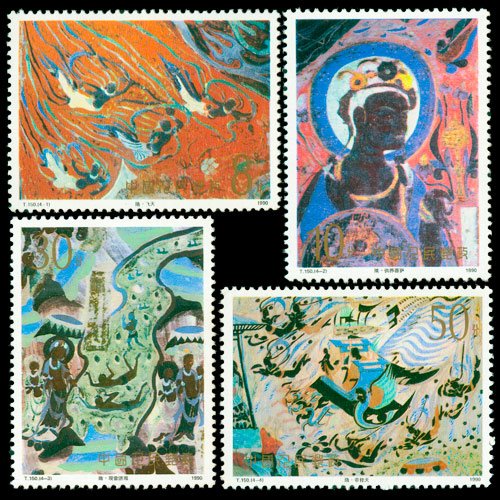
T150, Dunhuang Murals (3th Series)《敦煌壁画(第三组)》
Stamp Title: Dunhuang Murals (3th Series)
Serial number: T150
Values in set: 4
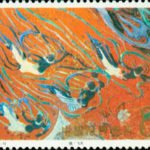
(4-1), Sui Dynasty, flying Apsaras, 8 fen, 54*40 mm
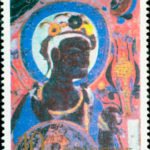
(4-2), (4-2) Sui Dynasty, Bodhisattva, 10 fen, 40*54 mm
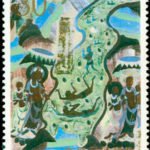
(4-3), Sui Dynasty, Avalokitesvara, 30 fen, 40*54 mm
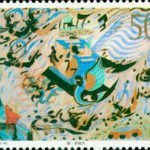
(4-4), Sui Dynasty, Sakyamuni, 50 fen, 54*40 mm
Date of issue: July 10, 1990
Denomination: 98 fen
Designers: Wu Jiankun, Ren Yu
Size of stamps:
54*40mm for Value 1, 4
40*54mm for Value 2, 3
Perforation: 11
Sheet composition:
20 (4*5) for Value 1, 4
20 (5*4) for Value 2, 3
Printing process: Photogravure
Printing House: Beijing Postage Stamp Printing Works
Dunhuang grottoes art is a solid art combining architecture, sculpture, and mural. Although Dunhuang murals only play a role of decoration, and a supplementary role to the sculptures in the Grottoes, but they feature the greatest number, the largest scale, the finest art skills and the richest content, providing very valuable information and material for research on ancient Chinese politics, economy, culture, military, geography, communication, social life, national relationship, religious history, art history, and exchanges with foreign countries and history of cultural exchanges. It is indeed a classic art heritage of great value.
In the 577 grottoes with Mogao grottoes as the principal one, there are more than 45,000 square meters of colorful murals. It was called the biggest museum of fine arts in the world. According research findings, Dunhuang murals can be divided into the following classes:
Buddha Figures: They refer to all kinds of gods and spirits, such as Buddha, Bodhisattva, and Buddha Guards, etc. worshiped by Buddhists. Most of them are painted in the pictures of Teaching Doctrine. In Mogao grottoes alone there are 12,208 figures of Buddha with different expressions and postures in 933 pictures of Teaching Doctrine.
Jingbian Painting: They refer to an art form that employs paintings and literature to make abstract Buddha sutra easy to understand. A drawing that explains abstract sutra is called Bianxiang, and the method of explaining sutra with words and singing is called Bianwen.
Legendary Mural: Its subject maters are traditional Chinese legends, which refer to the contents or subjects of Taoist thought appearing in the Northern Wei Dynasty (386-534). Occurrence of Taoist thoughts in Buddha grottoes reflects the combination of the Buddhist meditative absorption and Taoist Xujing (quiet and calm). It is also the influence of Buddhist thought and art on Chinese culture.
Almsgivers’ Figures: Almsgivers refer to those who believe in Buddhism and finance the building of grottoes. To show their sincere belief in Buddhism and leave fame in the future, they painted themselves, their family members and servants inside the grottoes when building the grottoes.
Decorative Painting: Rich and colorful decorative paintings are mainly used to decorate the construction of grottoes, and desk covers, clothes and containers. The pattern kept changing along with time, revealing outstanding painting skills and rich imagination of the artists. The patterns mainly include sunken panel, rafter, and edge decoration, etc.
Story Painting: To attract more and more people and spread Buddhism with great efforts, it is necessary to transmit the abstract and profound Buddhist sutra to ordinary people in simple words and vivid form. Therefore plenty of story paintings were painted in grottoes, which have exerted an imperceptible influence on people when they saw the murals. The stories are full of rich content and moving plot with strong life atmosphere and great charm.
Except the above-mentioned murals, there are also murals on buildings, containers, flowers and birds, animals, etc. Dunhuang Murals systematically reflect changes and art exchange history between China and western countries in respect of the art style of various periods in arrangement, figure, outline, and color, etc.
-

- (4-1), Sui Dynasty, flying Apsaras, 8 fen, 54*40 mm
-
- (4-2), (4-2) Sui Dynasty, Bodhisattva, 10 fen, 40*54 mm
-
- (4-3), Sui Dynasty, Avalokitesvara, 30 fen, 40*54 mm
-
- (4-4), Sui Dynasty, Sakyamuni, 50 fen, 54*40 mm
T150 敦煌壁画(第三组)
(1)8分,隋·飞天,2178.9万枚。
(2)10分,隋·供养菩萨,2037.4万枚。
(3)30分,隋·观音济难,2004.4万枚。
(4)50分,隋·帝释天,1553.9万枚。
发行日期:1990.7.10。影写版。P11。[Ph]祁铎。设计:吴建坤、任宇。印刷:北京邮票厂
(1)(4):54mm×40mm、20(4×5)。
(2)(3):40mm×54mm、20(5×4)。
敦煌(今甘肃省敦煌县西)是古代通往中亚和欧洲的交通要道。莫高窟(千佛洞)保存有4世纪至14世纪遗留的壁画、雕塑等艺术珍品;城南有鸣沙山、月牙泉等名胜;城西北有玉门关;西南有阳关遗址。
敦煌壁画是中国古代文化遗产中的瑰宝,也是表现佛教思想的精品,古代艺术家们以其卓越的才能和丰富的想象力,展现了历代人们的生活场景和美丽的神话传说。在描绘神话故事时,他们将美丽的传说与现实生活熔于一炉,表现了伟大的现实主义创作手法。
4-1 为“隋·飞天”,是莫高窟第206窟佛龛顶部的壁画。飞天画在佛背光火焰纹上方,在腾腾烈焰上成群地翔舞,色调因用土红色而更显炽烈。
4-2 为“隋·供养菩萨”。图中菩萨宝冠剑环敷贴金箔,增带璎珞装饰华贵,设色富丽,描绘精细。因颜料变质,肌肤成了黑色,但仍不失隋代盛期人物画杰作。
4-3 为“隋·观音济难”。观音菩萨大慈大悲,救苦救难,深得人心,后发展成久盛不衰的观音信仰。
4-4 为“隋·帝释天”,名因陀罗,是三十三天的主宰,即佛教的天帝。壁画中帝释天驾四龙车巡天,风驰电掣,华贵显赫的气派如同人间王者出行,但神话的景象远远超过了人间的现实。
Leave A Comment
You must be logged in to post a comment.