
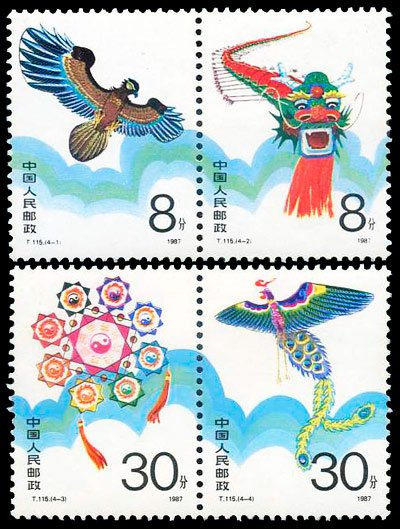
T115, Kites (2nd Set)《风筝(第二组)》
Stamp Title: Kites (2nd Set)
Serial number: T115
Values in set: 4
(4-1), Eagle, 8 fen, 30*40 mm
(4-2), Chinese dragon, 8 fen, 30*40 mm
(4-3), the Eight Diagrams, 30 fen, 40*40 mm
(4-4), Phoenix, 30 fen, 30*40 mm
Date of issue: April 1, 1987
Denomination: 76 fen
Designers: Pan Keming
Size of stamps: 30*40mm
Perforation: 11.5*11
Sheet composition: 50(10*5)
Printing process:Photogravure
Printing House: Beijing Postage Stamp Printing Works
The kite, a Chinese invention, has been praised as the forerunner of the modern airplane. In the pavilion of aircraft of the National Aeronautics and Space Museum, Washington D.C., a plaque says, “the earliest aircraft are the kites and missiles of China”.
The kite is mainly, but not only, a plaything. It has contributed to science and production. The first planes were shaped after the kite. In 1782, Benjamin Franklin, noted American scientist and statesman, studied lightning and thunder in the sky with the help of a kite and then invented the lightning rod. Kites are still used by some fishermen to lay bait in the sea to attract fish, or by photographers to take pictures of bird’s-eye view from high altitude.
-

- (4-1), Eagle, 8 fen, 30*40 mm
-
- (4-2), Chinese dragon, 8 fen, 30*40 mm

-
- (4-3), the Eight Diagrams, 30 fen, 40*40 mm
-
- (4-4), Phoenix, 30 fen, 30*40 mm
T115 风筝(第二组)
(1) 8分 鹰 915.65万枚
(2) 8分 龙头蜈蚣 915.65万枚
(3) 30分 八卦 605.4万枚
(4) 30分 凤凰 605.4万枚
发行日期:1987.4.1。影写版。P11.5×11。30mm×40mm。50(10×5)。
潘可明。印刷:北京邮票厂。(1、2)图连印。(3、4)图连印。
风筝又名“纸鸢”。相传春秋时公输般作木鸢以窥宋城,后来又用纸代木,称为“纸鸢”。五代时又在纸鸢上系竹哨,声如筝鸣,因此称“风筝”。式样繁多,有禽鸟虫鱼等。
4-1 为“鹰”。主图为展翅长空的鹰形风筝。鹰是力量、勇猛的象征。据说有时把老鹰风筝放上天空,能把鸟吓跑。
4-2 为“龙头蜈蚣”。主图为张着巨嘴的龙头和蜈蚣状身体的风筝腾空飞翔。龙头蜈蚣具有一种气势磅礴的豪壮之感。
4-3 为“八卦”。主图为呈阴阳八卦状分布的风筝凌空翱翔。八卦的图形是《周易》中所记载的乾、坤、震、巽、坎、离、艮、兑。分别代表天、土、雷、风、水、火、山、泽等八种自然现象。而其中乾、坤两卦是自然界和人类社会一切现象的根源。中间的“太极”是上下颠倒的两条阴阳鱼。八卦看似神秘,实际上是古人对天下万物一个简略的归纳。
4-4 为“凤凰”。凤凰是中国传说中的吉祥的百鸟之王,人们用自己所能想象出来的美丽羽毛打扮它,使它成为一种理想中的鸟类。
Leave A Comment
You must be logged in to post a comment.