
Seal Characters (pinyin: zhuàn shū), a style of the Chinese calligraphy, are divided into two categories, the greater and the lesser seal characters. The former, deriving from oracle-bone inscriptions, first appeared during the Zhou Dynasty and paved the way for the square-shaped Chinese characters with neat and regular character patterns. According to legend, the Grand Astrologer Zhou during the reign of King Xuan of the Zhou Dynasty wrote 15 articles in greater seal characters, which therefore came to be also called Zhou characters. The lesser seal characters are more simplified and standardized compared with the greater. They moved away from pictography and developed inito a more balanced and standard style of characters. They are also called Qin-style seal characters due to being collected and pared down by the Prime Minister of Qin, Li Si and others when the State of Qin unified China. The spread of lesser seal characters consolidated Chinese characters and represented the first character simplification movement in history. Seal characters are still widely used in calligraphy due to its gracefulness of patterns.
-
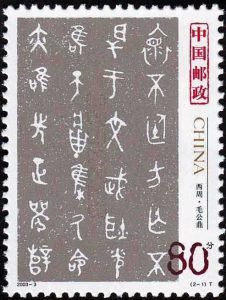
- (2-1), Duke Mao’s Tripod of the Western Zhou Dynasty, 80 fen, 30*40 mm
-

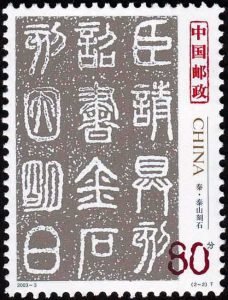
- (2-2), Carvings of Mount Tai of the Qin Dynasty, 80 fen, 30*40 mm
Stamp Title: Seal Characters (pinyin: zhuàn shū), An Ancient Style of Chinese Calligraphy
Serial number: 2003-3
Values in set: 2
Denomination: 1.60 yuan
Date of issue: Feb 22th, 2003
Designer: Wang Huming
Size of stamps: 30*40 mm
Perforation: 12
Sheet composition:
20 for sheet I; 8 for Sheet II (se-tenant)
Printing process: offset
Printer: Beijing Postage Stamp Printing House
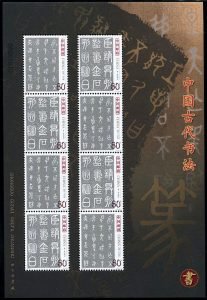
(1-1), Seal Characters, An Ancient Style of Chinese Calligraphy, 640 fen, 200*133 mm
2003年特种邮票《中国古代书法——篆书》
国家邮政局2003年2月22日发行《中国古代书法——篆书》特种邮票1套2枚。
(2-1)T 西周·毛公鼎 80分 950万枚
(2-2)T 秦·泰山刻石 80分 880万枚
志号:2003-3
版别:胶印
邮票规格: 30mm×40mm
齿孔度数: 12度
整张枚数: 版式一20(4×5);版式二 8枚(一、二图连印,4套邮票,发行量46万版,135mm×200mm)
设计者:王虎鸣
印制厂:北京邮票厂
邮票赏析及背景知识介绍:
中国邮政定于2003年2月22日发行《中国古代书法—-篆书》特种邮票1套2枚。
大篆,小篆的对称,狭义专指籀文,广义指甲骨文、金文、籀文和春秋战国时通行于六国的文字。毛公鼎通高53.8厘米,重34.7公斤。清道光末年(1850年)陕西省岐山县周原出土,现藏台北故宫博物院。毛公鼎是西周青铜器中赫赫有名的重器之一,造于西周晚期的宣王时期(公元前828年–公元前802年),因作者毛公而得名,铭文铸在鼎上,有32行,共497字,是现存青铜器铭文中最长的一篇。毛公鼎铭文,全文首先追述周代国君文王武王的丰功伟绩,感叹现时的不安宁,接着叙述宣王册命毛公,委任他管理内外事务,拥有宣布王命的大权。宣王一再教导毛公要勤政爱民,修身养德,并赐给他一些器物以示鼓励。毛公将此事铸于鼎上,以资纪念。其书法是成熟的西周金文风格,结构匀称准确,线条遒劲稳健,布局妥帖,充满了理性色彩,显示出金文已发展到极其成熟的阶段。
小篆,也叫秦篆,秦代通行的文字,是在籀文的基础上发展形成,字体匀圆齐整,较大篆简化。秦始皇统一中国后,采纳李斯的意见,推行统一文字的政策,以小篆为正字,淘汰通行于其他地区的异体字,对汉字的规范起了很大作用。存世有《琅琊台刻石》和《泰山刻石》残石。《泰山刻石》的作者秦相李斯(?–公元前208年),可称得上是我国书法史上第一位有记载的书法家。《泰山刻石》的书体是秦统一后的标准字体小篆。其结构特点,直接继承了石鼓文的特征,比石鼓文更加简化和方整,字呈长方形,线条圆润流畅,疏密匀停,给人以端庄稳重的感受。唐张怀称颂李斯的小篆是:“画如铁石,字若飞动”,“骨气丰匀,方圆妙绝”。
Knowing China Through Chinese Postage Stamps.
Leave A Comment
You must be logged in to post a comment.