
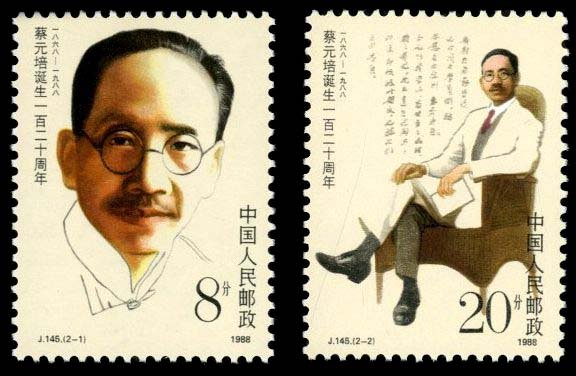
J145, 120th Anniv. of Birth of Cai Yuanpei《蔡元培诞生一百二十周年》
Stamp Title: 120th Anniv. of Birth of Cai Yuanpei
Scott No: 2132, 2133
Serial number: J145
Values in set: 2
(2-1), Portrait of Cai Yanpei, 8 fen, 40*30 mm
(2-2), Portrait of Cai Yanpei, 20 fen, 40*30 mm
Date of issue: January 11, 1988
Denomination: 28 fen
Designers: Yan Baozhen
Size of stamps: 30*40mm
Perforation: 11.5*11
Sheet composition: 50(10*5)
Printing process: Engraving and photogravure
Printing House: Beijing Postage Stamp Printing Works
Cai Yuanpei (1868-1940) was born in Shaoxing, Zhejiang. His job as a proofreader at Guyue Library in his teenage years enabled him to read classics extensively. After the Sino-Japanese War of 1894-1895, he began to expose himself to western knowledge. He sympathized with the reform campaign. In 1899 he came back to Shaoxing and held the post of Supervisor at Shaoxing China West School. In July 1902, he went to Shanghai and taught at Nan Yang College. In 1903, he organized China Education Society in collaboration with Jiang Guanyuan and other people. He was chief steward of the organization. He also set up a school and an association for women in Shanghai where he served as general manager. In 1904 he went to study in Germany. In 1912 when the Republic of China was founded, Cai Yuanpei served as education minister for the provisional national government in Nanjing. He was a champion of adopting the western education system and promoting a co-education for boys and girls in the same school. He was the very person who ushered the western education system into China. After the failure of the Second Revolution, he exiled himself to France, where he and Li Shiceng co-founded an organization for Chinese students engaged in work-study programs. In 1917 he came back and served as president of Beijing University. He advocated the New Culture Movement and called for academic researches. He supported students¡¯ patriotic activities in the May Fourth Movement and rescued arrested students in many ways. After he was forced to resign, he went on a few lecture and study trips to France and GB. After the September 18 Incident, Cai called for efforts against the Japanese invasion and advocated the cooperation between the Communist Party and the Kuomintang. In 1932, he founded and organized China League for Protection of Civil Rights in collaboration with Song Qingling and Lu Xun in patriotic efforts to fight the invading Japanese troupers. He died of illness in Hong Kong on March 5, 1940 and was buried in a Chinese cemetery in Hong Kong.
-

- (2-1), Portrait of Cai Yanpei, 8 fen, 40*30 mm
-
- (2-2), Portrait of Cai Yanpei, 20 fen, 40*30 mm
J145 蔡元培诞生一百二十周年
2-1为“学界泰斗”。 2-2为“人世楷模”。
发行日期:1988.1.11。影写版。P11.5*11。 30mm*40mm。 50(10*5)。 [G]。
设计:颜宝臻。印制:北京邮票厂。
蔡元培(1868~1940),浙江绍兴人。著名教育家、学者。清末光绪进士,翰林院编修。中日甲午战争后,他开始接触西学,同情维新派。1898年开始兴办教育,提倡新学,曾任绍 兴中西学堂监督。1902年与章炳麟等发起组织中国教育会,他担任会长,提倡民权,宣传排满革命。1904年与陶成章等组织光复会,被推为会长。次年加入同盟会,为中国上海分部主盟员。1907年赴德留学,1912年回国,任南京临时政府教育总长,提出修改学制,实行小学男女同校,废除读经等改革教育的措施。又与吴玉章等组织留法勤工俭学会,组织华法教育会。1917年任北京大学校长,积极支持正在酝酿中的新文化运动,提倡学校研究,号召学生研究高深学问,不要追求做官发财。强调“仿世界各大学通例,循思想自由原则,取兼容并包之义。”提倡科学、民主,反对旧思想和旧礼教;提倡白话文,反对文言八股,使北大成为新文化运动的壁垒。 1927年后曾任中央研究院院长。1931年 “九?一八”事变后,力主抗日。为保障中国人民的民主权利,与宋庆龄、鲁迅等组织中国民权保障同盟,任副主席。抗日战争期间在香港病逝。
本套邮票共2枚。
2-1为“学界泰斗”。
2-2为“人世楷模”。
蔡元培先生不仅学富五车,融贯中西,而且在主持中国近现代教育时开创了新的学习体制。他在北京大学时,采取了兼容并包主义,扶植后学、新学,不少现代著名学者和思想家均受益于他,如胡适、鲁迅、梁漱溟等,称其为“人世楷模”的确恰如其分。
Leave A Comment
You must be logged in to post a comment.