
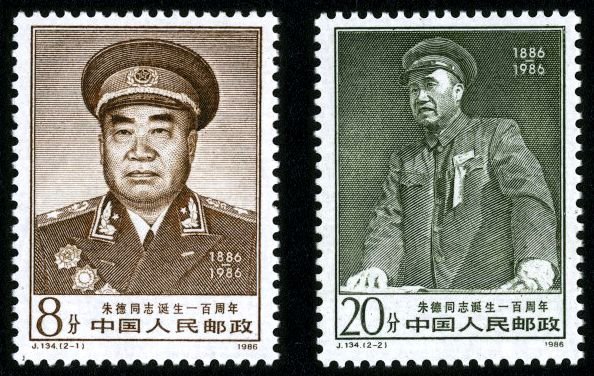
J134, Centenary of Birth of Zhu De《朱德同志诞生一百周年》
Stamp Title: Centenary of Birth of Zhu De
Scott No: 2068-69
Serial number: J134
Values in set: 2
(2-1), Portrait of Marshal Zhu De, 8 fen, 30*40 mm
(2-2), Speech at then Army Day in 1950, 20 fen, 30*40 mm
Date of issue: December 1, 1986
Denomination: 28 fen
Designers: Hu Zhengyuan
Engraver: Hu Zhengyuan, Gao Pinzhang
Size of stamps: 30*40mm
Perforation: 11.5*11
Sheet composition: 50(10*5)
Printing process: Engraving and photogravure
Printing House: Beijing Postage Stamp Printing Works.
Zhu De was born December 18, 1886, in Sichuan Province. Zhu De came from a poor family in which only eight of fifteen children survived. He was the “Grand Old Man” of the Red Army. He was Mao’s closest ally. He was the Commander in Chief during the Long March.
After studying in Germany, he met Zhou Enlai and soon became a Communist leader. In 1923, he was the nationalist Chief of Public Security in Nanchang and of the KMT officers training corps. It was still a secret that he was a Communist Party member. He was always a strong supporter of Mao and the Zunyi Conference that decided the leadership of the Communist Party and the Red Army. The trio of Bo Gu, Otto Braun, and Zhou Enlai had been the leaders at the beginning of the Long March. But after disastrous defeats at the Xiang River crossing and the general direction of the Red Army, distrust was springing up against the strategy of the leaders. The Zunyi Conference and Mao’s success set the course of China’s affairs for the next 50 years.
Zhu was in the First Top Command during the Long March. Zhang Guotao and Zhang’s Fourth Route Army for held him virtual prisoner over a year. Zhang tried to take over the leadership of the Red Army and the Chinese Communist Party. Zhu then escaped to join the Red Army. Zhu was the Commander in Chief of the 8th Route Army during the Sino-Japanese war and later of the PLA (People’s Liberation Army.) At the founding ceremony of the People’s Republic of China on October 1st, 1949, as the Commander in Chief of the People’s Liberation Army, he was on the reviewing stand next to Chairman Mao.
In 1967, during the Cultural Revolution, a poster named Zhu De a “Big Warlord” and a “Black General.” Zhou Enlai helped to save him until he died on July 7, 1976.
-

- (2-1), Portrait of Marshal Zhu De, 8 fen, 30*40 mm
-
- (2-2), Speech at then Army Day in 1950, 20 fen, 30*40 mm
J134 朱德同志诞生一百周年
2-1为“朱德元帅像”。
2-2为“1950年朱德同志在“八一”建军节大会上讲话”。设计者选用了朱德在1950年“八一” 建军节上讲话的场景。
发行日期:1986.12.1。雕刻版。P11.5*11.30mm*40mm。50(10*5)。[G]。
[A](2-1)郑景康。(2-2)齐观山。设计:呼振源。[E]高品璋、呼振源。
印制:北京邮票厂。
朱德(1886—-1976),字玉阶,四川仪陇县人。1909年考入云南陆军讲武堂,同年加入中国同盟会,参加辛亥革命。1913年在滇军任营长、团长、旅长,曾参加护国、护法战争。1922年赴德国留学,同年加入中国共产党。1925年赴苏联学习军事,次年回国。1927年在南昌创办革命军第三军军官教导团,参加“八一”南昌起义,任起义军第九军副军长。1928年4月率起义军余部到达井冈山,与毛泽东领导的部队会师,成立了工农革命军第四军,任军长,此后历任中国工农红军第一军副总指挥,红一方面军总司令、红军总司令。抗日战争时期,任中共中央军委副主席、八路军总司令。解放战争时期,任中国人民解放军总司令。中华人民共和国成立后,历任中央人民政府副主席,中国人民解放军总司令,中华人民共和国主席,1955年被授予元帅军衔。他曾是第二、三、四届全国人大常务委员会委员长,中国共产党第六、七届中央政治局委员,中央书记处书记,第八届中央委员会副主席,第九届中央政治局委员和第十届中央政治局常委。1976年7月6日,朱德在北京病逝。
在邮票设计上,作者采用了文武线(文为细线,武为粗线)内外框的形式。图案以文线为内框,以武线为外框,文字、面值和图案统一在一个整体画面里,使主题更加突出,文字、面值醒目,画面开阔而不拘谨。
2-1为“朱德元帅像”。画面是朱德身着元帅礼服的标准肖像。图案中,人物形象神态庄重,威严英武;
2-2为“1950年朱德同志在“八一”建军节大会上讲话”。设计者选用了朱德在1950年“八一” 建军节上讲话的场景。图案中,人物神采奕奕,面容慈详。作者用深色背景托出人物形象,使之显得更加高大魁梧。整个图案在绘画关系上以浅衬深,以深衬浅,富于视觉美感。
本套邮票选用单色雕刻版,韵味隽永,庄重古朴,精细入微。邮票的原版雕刻是雕刻者以邮票图稿为依据在艺术上的再创造。2-1由高品璋雕刻,人的服饰用粗密的主线、细疏的辅线;脸的亮部用由小到大、由浅入深的渐变点,脸的暗部用主辅交叉线,把人物形象刻划得惟妙惟肖,细腻传神。这枚邮票以其精深的刀功和丰富的表现力被评为1986年度中国的最佳雕刻邮票。2-2由设计者自行雕刻,在方寸之间准确生动地刻划了人物形象
Leave A Comment
You must be logged in to post a comment.