
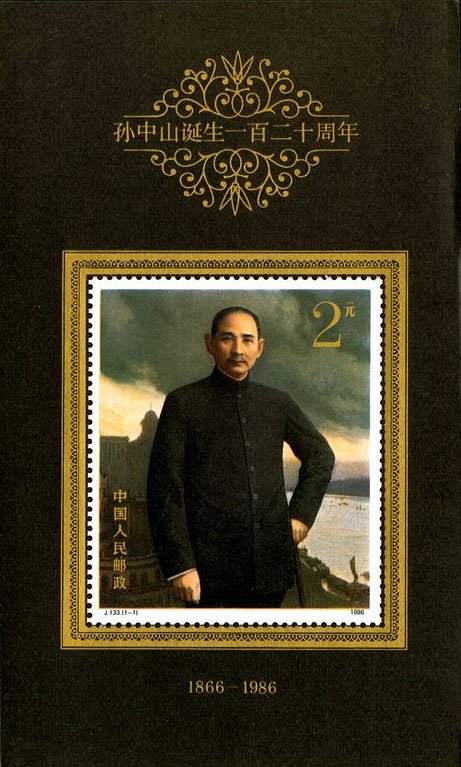
J133, 120th Anniv. of the Birth of Dr. Sun Yatsen《孙中山诞生一百二十周年(小型张)》
Stamp Title: 120th Anniv. of the Birth of Dr. Sun Yatsen
Scott No: 2067
Serial number: J133
Values in set: 1
(1-1), 120th Anniv. of the Birth of Dr. Sun Yatsen, 200 fen, 82*137mm/ 52*62 mm
Date of issue: November 12, 1986
Denomination: 200 fen
Designers: Xin Shangyi
Size of stamps: 52*62mm
Size of S/S: 82*137mm
Perforation: 11.5
Printing process: Photogravure
Printing House: Beijing Postage Stamp Printing Works.
Dr. Sun Yat-sen, also known as Sun Chung-shan and Sun Wen, was born in 1866 in a coastal village of Hsiangshan County, Kwangtung Province. After receiving his early education in both Chinese and Western schools, he moved to Hawaii in 1879, where he attended Iolani and Oahu Colleges. In 1883, he returned to China to continue his studies, concentrating on the Chinese classics and history. He later moved to Hong Kong to attend Queen’s College and in 1892 graduated from Hong Kong Medical College.
Seeing the weakness of the imperial Manchu court and the encroachment on China by foreign powers, Sun gave up his medical career to pursue political reform. In 1894, together with a group of overseas Chinese youths, Sun established his first revolutionary organization, the Hsing-chung Hui (Society for Regenerating China), in Honolulu, Hawaii. His political ideals are summarized in a set of doctrines called the Three Principles of the People–nationalism, democracy, and the people’s well-being–which were designed to build an independent, democratic , and prosperous China.
Over the next 16 years, Sun and his followers launched ten futile attempts to topple the corrupt imperial Manchu court. Finally, on October 10, 1911, forces loyal to Sun took over Wuchang, the capital of Hupei Province. Thereafter, other provinces and important cities joined the revolutionary camp and declared independence from the Manchu government. On December 29, 1911, Sun was elected provisional president of the new republic by delegates from 16 of the 17 provinces gathered in Nanking. He was inaugurated on January 1, 1912, the founding day of the ROC.
To preserve national unity, Sun relinquished the presidency on April 1, 1912, to military strongman Yuan Shih-k’ai, who declared himself emperor in 1915. Sun and other leaders moved the revolutionary effort to Japan until Yuan Shih-k’ai’s death in 1916. In 1917, the Provisional Assembly elected Sun to lead the Chinese Military Government based in Canton, and in 1921 Sun assumed office as president of the newly formed government in Canton. He devoted the rest of his life to uniting China’s feuding factions.
Sun died of illness on March 12, 1925, at the age of 59 in Peking. In 1940, he was posthumously declared the Founding Father of the Republic of China for his life-long contributions to the revolution.
J133M 孙中山诞生一百二十周年(小型张)
发行日期:1986.11.12。影写版。P11.5。 [G]。设计:靳尚谊。印制:北京邮票厂。
小型张规格:82mm*137mm。
邮票规格:52mm*62mm。
孙中山(1866-1925),名文,字逸仙,广东香山(今中山)人。1892年香港西医书院毕业。1894年上书李鸿章,提出革新政治主张,被拒绝,遂赴檀香山组织兴中会。次年在香港设机关,准备在广州起义,未成。1900年派人至惠州(今广东惠阳)三洲田发动起义,失败后继续在国外开展革命活动。
纪念孙中山诞辰一百二十周年邮票小型张。这张画幅面比较大一些,将近一米左右。这幅作品比较概括地表现了孙中山的经历,作者设计的是孙中山站着的半身像,背景是本世纪初广州珠江沿岸的一些景象,反映当时的时代特点,孙中山的形象画得也还可以。这个邮票小型张发行以后被评为当年的最佳邮票,影响也很大。邮电部有个规定,凡是设计原稿均由邮电部保存,因此这幅《孙中山》现在由邮电部邮票博物馆收藏。后来在《孙中山与华侨》的展览中,作者又重新复制了一张,也被主办单位收藏了,这三幅历史人物肖像创作和作者其他当代肖像创作同时或交叉进行。
Leave A Comment
You must be logged in to post a comment.