
-
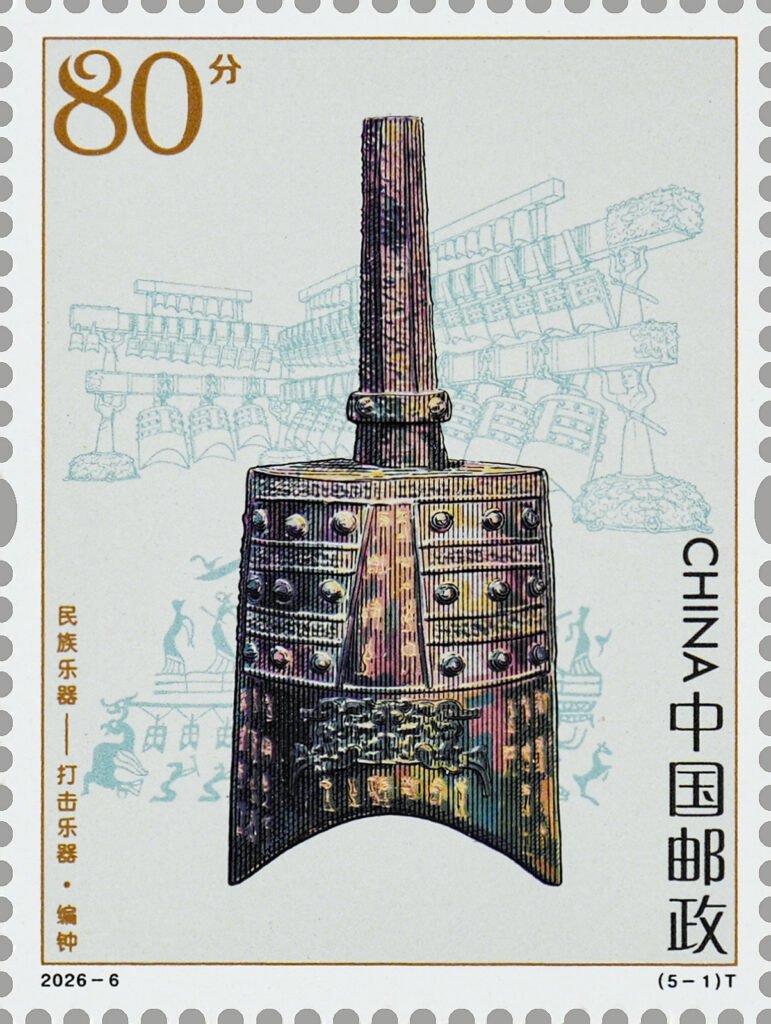
- 2026-6(5-1)T 《民族乐器——打击乐器》特种邮票,编钟,面值80分,曾侯乙编钟背景,胶雕套印邮票。China Post 2026 special stamp Bianzhong bronze chime bell, face value 0.8 CNY.
-

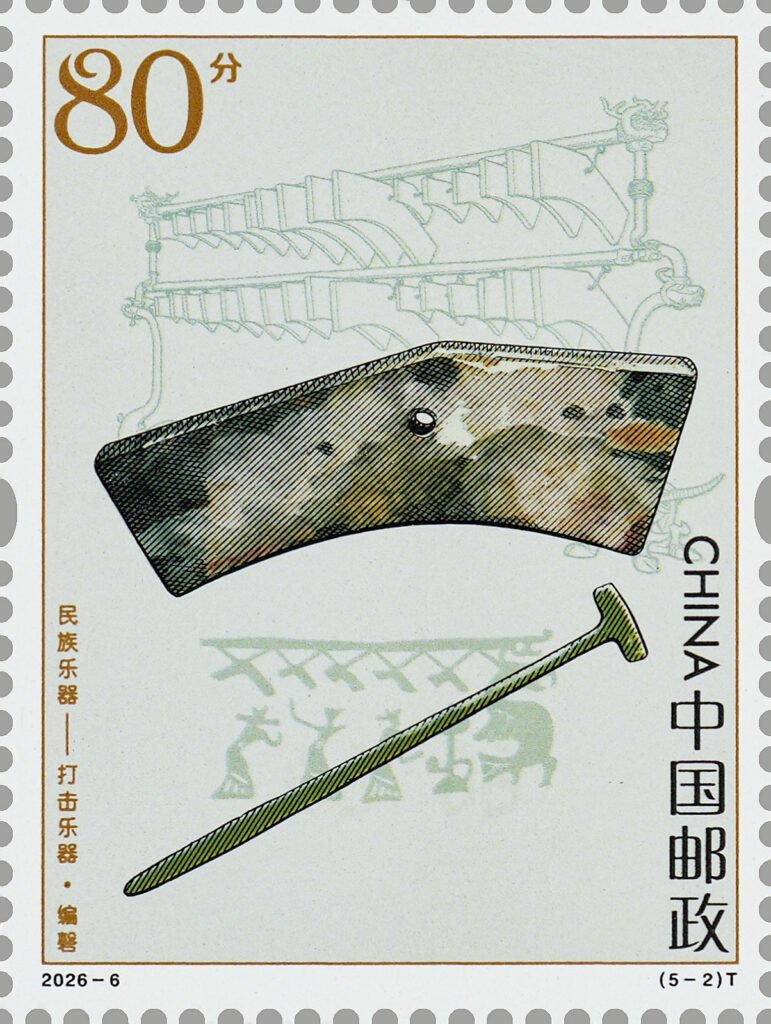
- 2026-6(5-2)T 《民族乐器——打击乐器》特种邮票,编磬,面值80分,战国宴乐渔猎攻战纹图壶纹样背景,胶雕套印邮票。China Post 2026 special stamp Bianqing stone chime, face value 0.8 CNY.
-
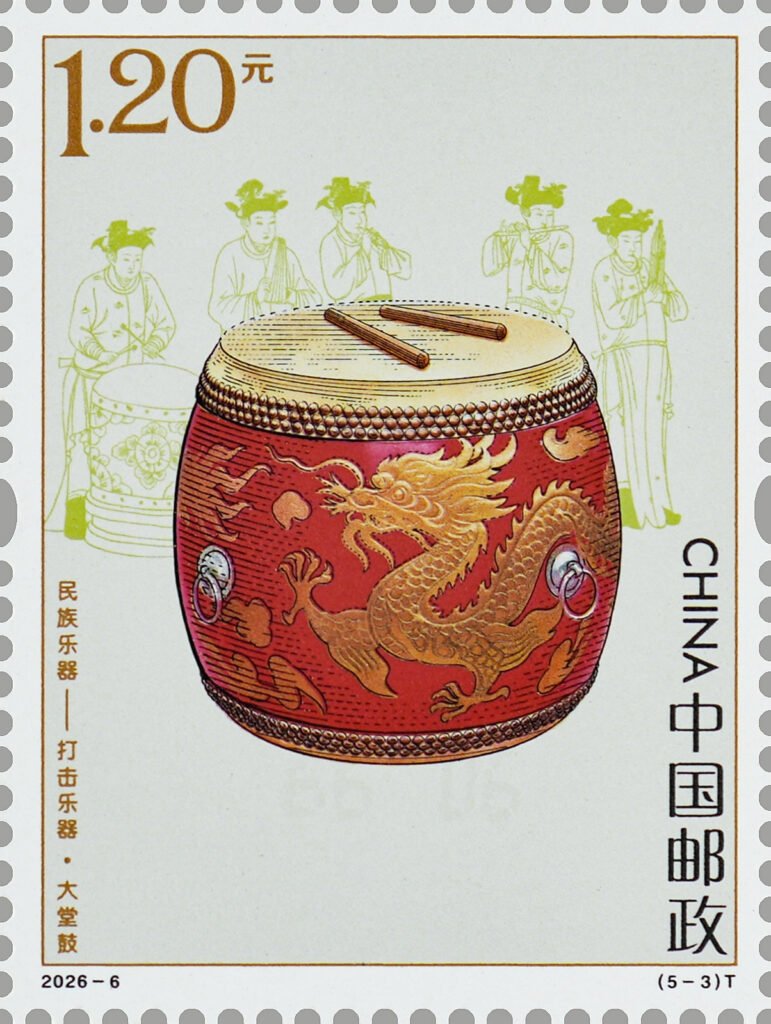
- 2026-6(5-3)T 《民族乐器——打击乐器》特种邮票,大堂鼓,面值1.2元,辽代张文藻墓散乐壁画背景,胶雕套印邮票。China Post 2026 special stamp Big Hall Drum, face value 1.2 CNY.
-
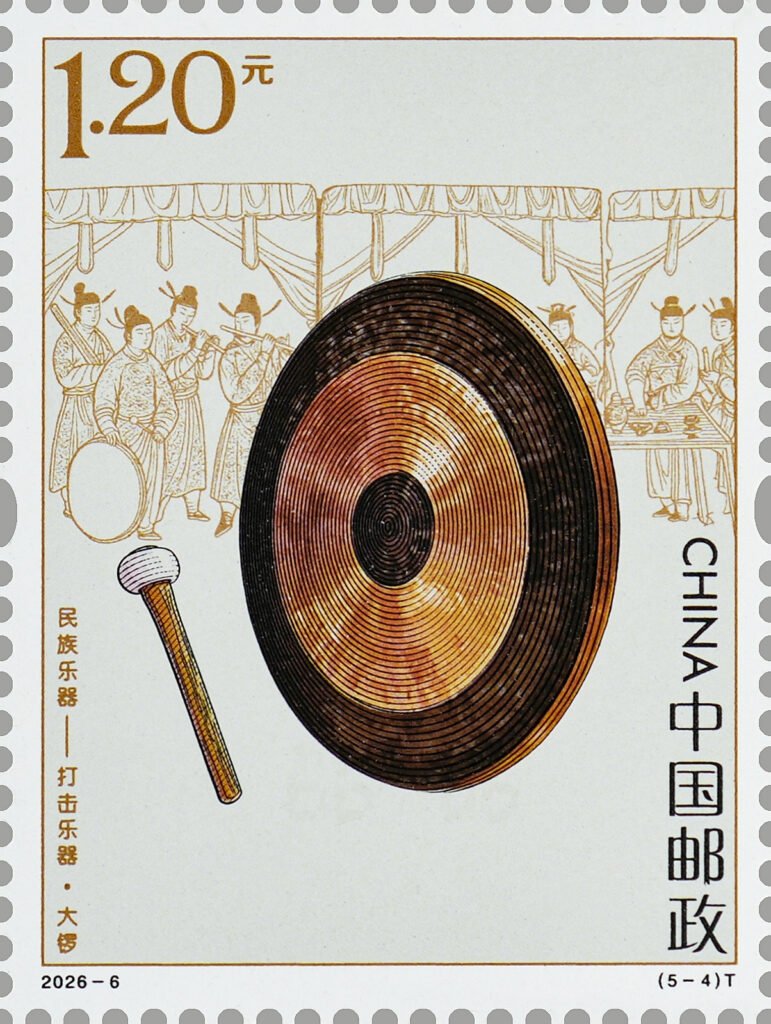
- 2026-6(5-4)T 《民族乐器——打击乐器》特种邮票,大锣,面值1.2元,陇西宋墓宴乐图砖雕背景,胶雕套印邮票。China Post 2026 special stamp Large Gong, face value 1.2 CNY.
-
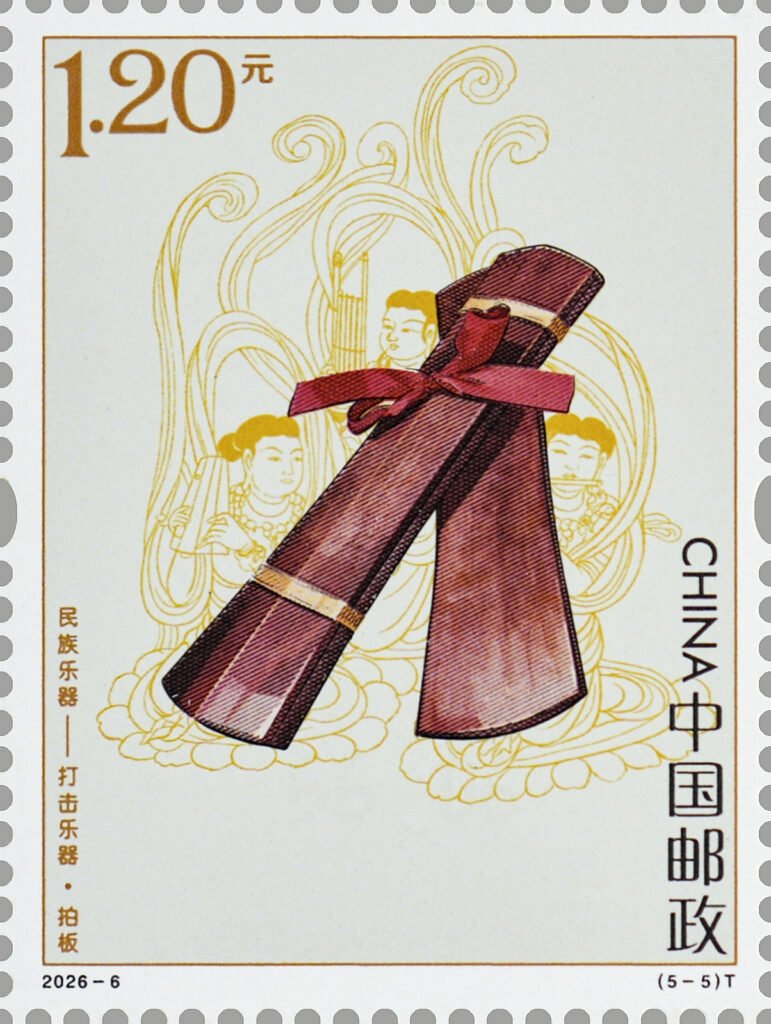
- 2026-6(5-5)T 《民族乐器——打击乐器》特种邮票,拍板(檀板),面值1.2元,五代榆林窟化生童子伎乐图背景,胶雕套印邮票。China Post 2026 special stamp Clappers, sandalwood ban, face value 1.2 CNY.
Stamp Titel: Traditional Chinese Musical Instruments – Percussion Instruments
Serial number: 2026-6
Values in set: 5
(5-1) T Bianzhong (Bronze Chime Bells) CNY 0.80
(5-2) T Bianqing (Stone Chimes) CNY 0.80
(5-3) T Big Hall Drum CNY 1.20
(5-4) T Large Gong CNY 1.20
(5-5) T Clappers CNY 1.20
Date of issue: June 13th, 2026
Denomination: 520 fen
Designer: Shen Jiahong, Shang Ying
Size of stamps: 30 * 40 mm
Perforation: 13.5
Sheet composition: 20 (4 sets)
Size of sheet: 180 * 200 mm
Printing process: Offset + engraving
Printing House: Beijing Postage Stamp Printing Works
P.S. Chinese traditional musical instruments are generally categorized into four groups: wind, percussion, plucked and bowed instruments. Percussion instruments produce sound by striking, shaking, rubbing or scraping. Some percussion instruments can deliver not only rhythms but also melodies and harmonies, forming an indispensable part of traditional Chinese art. This is the 3rd release of the *Chinese National Musical Instruments* stamp series, preceded by *Plucked Instruments* (T.81,1983) and *Bow-stringed Instruments* (2002-4).
Bianzhong are bronze chime bells invented and used in ancient China. Originating in the Zhou Dynasty, they flourished from the Spring and Autumn, Warring States periods through the Qin and Han dynasties. Bells of varying sizes and pitches are hung on a wooden frame. Musicians strike them with T-shaped mallets and long beaters; each bell generates a definite pitch. The stamp background adopts the Zeng Houyi chime bells, with intact bell frame and neatly suspended bells, demonstrating the perfect integration of science and art. As bronze percussion instruments, bianzhong deliver grand, rich and pure tones with long reverberation. Music performed on bianzhong is solemn and magnificent, creating an impartial and harmonious ritual‑music atmosphere.
Bianqing are traditional stone percussion instruments of ancient Han people. They are usually polished from limestone or marble. Stone slabs of different sizes are mounted on a wooden frame and struck with small mallets. The background at the bottom of the stamp is a partial pattern from the Warring States bronze pot with scenes of feast, music, fishing and warfare. The carving depicts an ensemble playing under a chime frame, vividly showing a lively musical and dance performance. Bianqing produce crisp, bright and penetrating sounds, ethereal like mountain spring water. When played alongside bianzhong, they achieve the heavenly harmony of “metal and stone resonance”, offering peaceful and distant auditory enjoyment.
The big hall drum has a wooden frame covered with skins on both sides. Variants include flowerpot drums and vat drums, also known simply as Chinese big drums. It is mounted on a stand and struck with two wooden drumsticks, widely used in Chinese instrumental ensembles and accompaniment for opera and dance performances. The stamp background features the mural of music performers from the Zhang Wenzao tomb of the Liao Dynasty in Xuanhua. The mural portrays seven performers; the leftmost player strikes a big drum while wearing a flower-patterned yellow robe. The drum rests on a round base, with a red body painted with peonies and clearly visible skin rivets. The big hall drum has a large drumhead, delivering deep, broad and powerful tones. Its sound is highly impressive, stirring emotions and adding massive texture to music, endowing compositions with forceful rhythm and overwhelming momentum.
The large gong, also called Chao gong, sieve gong or black gong, retains unpolished black surfaces on rim and centre. It comes in large, medium and small sizes. Large gongs measure over 80 cm in diameter and are struck while suspended from a wooden frame. The stamp background uses a brick carving of musical performance from a Song tomb in Longxi, depicting a zaju opera scene. On the left side stands an accompanying musician holding a huge gong with a hole drilled on the edge for rope suspension. The musician holds the gong with his right hand, resting its bottom on the ground, ready to strike with a small hammer in his left hand. The large gong belongs to idiophones. It yields resonant, deep tones with long sustain. Its sound carries strong impact; in celebrations it can set a joyous and festive mood with powerful emotional expression.
Clappers, often made of sandalwood and hence also named sandalwood clappers, varied in number of slabs across dynasties according to application. Modern clappers normally consist of three wooden slabs: two front pieces and one back piece linked by cords through drilled holes. The performer grips the back slab and strikes it against the front two to produce sound. Clappers are widely used in folk ensembles and opera accompaniment bands. The stamp background is taken from the mural of heavenly child musicians in Cave 16, Yulin Grottoes of the Five Dynasties. Three boys kneel on lotus seats floating in the void; the child on the left concentrates on playing clappers. Clappers produce solid, short and crisp sounds. They have no fixed pitch and mainly serve to maintain tempo and conduct the ensemble. In ensemble music, their clear sound balances the deep tones of drums and gongs, keeping the whole melody well-structured and dynamically controlled.
The whole stamp set continues the consistent design language of the series, centering on the core concept of “inheriting ritual and music civilisation and reflecting evolution from ancient times to present”. The foreground presents physical forms of traditional instruments, while elegant line drawings of ancient paintings and cultural relics form the background. The miniature canvas blends ancient and modern charm, building a cultural scene where ritual and music resonate and time and space meet. It vividly interprets the inheritance and renewal of Chinese ritual and music civilisation in modern times. The stamps support AR technology. Scanning the stamps with compatible software triggers corresponding instrumental music for each stamp, breaking the limit of static viewing and enabling multi-dimensional experience combining text, images and sounds.
Printed by Beijing Stamp Factory with offset-engraving combined technology, the set features delicate artwork and rich colours with smooth transitions on backgrounds and decorative patterns. Engraved lines shape the percussion instruments, delivering sharp outlines and strong three-dimensionality with tangible embossed texture by touch. The engraving technique perfectly captures material features, craftsmanship and cultural connotations of the instruments. It improves anti-counterfeiting performance and endows the stamps with unique appeal.
2026年特种邮票《民族乐器 – 打击乐器》
中国邮政 2026 年 6 月 13 日发行《民族乐器 —— 打击乐器》特种邮票 1 套 5 枚。
(5-1)T 编钟 80 分
(5-2)T 编磬 80 分
(5-3)T 大堂鼓 1.2 元
(5-4)T 大锣 1.2 元
(5-5)T 拍板 1.2 元
志号:2026-6
邮票规格:30×40 毫米
齿孔度数:13.5 度
整张枚数:20 枚(4 套,5 枚连印)
整张规格:180×200 毫米
版别:胶雕套印
防伪方式:防伪纸张、防伪油墨、异形齿孔、荧光喷码
设计者:沈嘉宏、尚盈
雕刻者:杨志英、李昊、尹晓飞、徐喆
责任编辑:温文雅
印制厂:北京邮票厂有限公司
计划发行数量:392 万套,其中零售分配量 55 万套
全套总面值:5.20 元
版式说明:仅发行 20 枚大版
出售渠道:全国指定邮政网点、集邮网厅、中国邮政手机客户端。
P.S. 民族乐器一般分为吹、打、弹、拉四大类。打击乐器是一种以打、摇动、摩擦、刮等方式产生效果的乐器,有些打击乐器不仅仅能产生节奏,还能作出旋律与和声的效果,这些打击乐器是中国传统艺术中不可缺少的部分。本套邮票为 “民族乐器” 系列第三套,此前已发行《拨弦乐器》(T.81-1983)、《拉弦乐器》(2002-4)。
编钟为青铜铸造,最早由中国制造并使用,兴起于周代,盛行于春秋战国至秦汉时期。其由大小不同的扁圆钟按音调高低悬挂于木制钟架,通过丁字形木槌和长棒敲击发声,每个钟可发出固定音高。邮票背景选用了曾侯乙编钟,其钟架完好,钟体井然有序地悬挂其上,展现出科学与艺术的高度结合。编钟作为青铜铸造的打击乐器,其音色宏大、浑厚且纯净,余音悠长。其演奏的乐曲庄严肃穆、气势恢宏,营造出一种中正和谐的礼乐氛围。
编磬是中国古代汉民族传统打击乐器,通常由石灰石或大理石磨制而成,通过悬挂不同规格的磬片于木架上组成,以小槌敲击发声。画面下方背景则选用了战国宴乐渔猎攻战纹图壶局部纹样,所绘整个乐队在一套钟磬架下面演奏,生动表现了热闹的乐舞表演场面。编磬音色清脆、明亮、剔透,具有极强的穿透力,宛如山间清泉流淌般空灵清远。其演奏的乐曲听起来雅致脱俗,与编钟配合时形成 “金石和鸣” 的天籁之音,给人以宁静致远的听觉享受。
大堂鼓双面蒙皮,鼓框木制。根据不同形制又分花盆鼓、缸鼓。也称大鼓、中国大鼓等。演奏时置于鼓架之上,用两根木制鼓槌击奏。常用于中国器乐合奏和戏曲、歌舞音乐伴奏。邮票背景选用了辽宣化张文藻墓散乐壁画。该壁画由七人组成,最左侧一人击大鼓,着点花黄袍。圆形鼓座着地安放,大鼓置于鼓座上,鼓身红地,饰彩绘牡丹,皮膜鼓钉历历可见。大堂鼓鼓面较大,音色低沉、宽厚而雄壮。其演奏的乐曲听起来极具震撼力,咚咚的鼓声往往让人热血沸腾,为整体音乐增添浓重的厚实感,赋予整个乐曲铿锵有力的节奏与气吞山河的气势。
大锣又称抄锣、筛锣、黑锣,其锣边和锣心不刮光,呈黑色,分大、中、小三种。大锣锣面直径 80 厘米以上,演奏时悬于木架上击奏。邮票背景选用了陇西宋墓宴乐图砖雕局部,内容为一杂剧表演场面。画面左侧为伴奏乐队,一人提锣站立。此锣体巨大,光面,边际穿孔系绳。乐人右手提锣,下端搁于地面,左手持小锤待奏。大锣属于体鸣乐器,其音色洪亮、浑厚、深沉,余音悠长持久。其演奏的乐曲具有一种强烈的震撼感和压迫感,但在庆典中,它又能烘托欢快热烈、喜气洋洋的盛大场面,极具情绪渲染力。
拍板因常用檀木制作,又名檀板。历代拍板因使用目的不同,板的数量也不一致。现代拍板一般由三块板组成,前组两块,后组一块,板上有孔,用绳穿连,演奏时左手执底板,使与前两板相碰发音,广泛应用于民间器乐合奏和各种戏曲伴奏乐队。邮票背景选用了五代榆林窟第 16 窟化生童子伎乐图。三童子各跪于一莲座上在虚空遨游,左侧童子持拍板专注地演奏。拍板音色坚实、短促、清脆响亮。其演奏的乐曲听起来节奏分明、干净利落,它没有固定音高,主要起到统领节奏、指挥乐队的作用。合奏中,拍板的清音能中和鼓锣的浑厚之声,使整体旋律更加条理清晰、张弛有度。
整套邮票延续系列化设计风格,紧扣 “传承礼乐文明,彰显古今流变” 的核心立意。画面前景聚焦传统乐器实物形象,背景以素雅线描演绎古画、馆藏文物中的经典乐器形象,于方寸间融汇古今雅韵,营造礼乐相和、时空对望的文化意境,生动诠释中华礼乐文明的赓续传承与时代焕新。邮票搭载 AR 技术,使用相应软件对准邮票扫一扫后可听到五枚邮票上乐器对应乐曲,打破静态观赏局限,实现图文、乐器、音律多维融合,丰富邮票集藏体验。
该套邮票由北京邮票厂采用胶雕套印工艺印制,画面细腻、色彩丰富,背景与装饰纹样色彩过渡自然。雕刻线条运用于打击乐器主体部分,使乐器轮廓分明、立体感强,通过触摸可感明显的浮雕质感。雕刻工艺将乐器的材质特性、工艺细节与文化内涵完美融合,既提升防伪性能,又为邮票增添了独特魅力。
Leave A Comment
You must be logged in to post a comment.