

2003-26, Bronze Wares of the Eastern Zhou Dynasty《东周青铜器》
Stamp Title: Bronze Wares of the Eastern Zhou Dynasty
Serial number: 2003-26
Values in set: 8
(8-1), Square Plate with Turtle and Fish Patterns, 60 fen, 50*30 mm
(8-2), Gui of the Duke of Qin, 60 fen, 50*30 mm
(8-3), Iron-footed Tripod of the King of Zhongshan, 80 fen, 50*30 mm
(8-4), Gourd-shaped Ladle of Yi the Marquis of Zeng, 80 fen, 50*30 mm
(8-5), Divine Animal Wine Vessel, 80 fen, 30*50 mm
(8-6), Wine Vessel with Phoenix Pattern, 80 fen, 30*50 mm
(8-7), Square Pot with the Design of Lotus and Cranes, 100 fen, 30*50 mm
(8-8), Bronze Tripod with a Dragon-shaped Handle, 200 fen, 30*50 mm
Denomination: 7.40 yuan
Date of issue: 13th December 2003
Designer: Wang Xu
Size of stamps:
50*30 mm for Values 1,2,3,4 ;
30*50 mm for Values 5,6,7,8 ;
Perforation: 11.5
Sheet composition:
16 for Sheet I; 8 for Sheet II
Printing process: Photogravure-engraving
Printer: Beijing Postage Stamp Printing House
Background:
Smelting and production of bronze wares in China started in the Xia Dynasty (c.2100 BC — c.1600 BC), and developed into a complete system in the Shang and Zhou Dynasties. In the Zhou Dynasty, with the decline of the imperial power, the function of bronze wares lessened as representation of the emperor’s rituals and the social estate system. The states made sacrificial vessels by themselves such as the traditional ding (tripod) and gui (round-mouthed food vessel), and newly invented bronze wares like zun (wine vessel), fou (percussion instrument) and he (a tripod vessel) with a loop handle. The bronze wares were engraved with beautiful, exquisite patterns usually of winding, intertwined dragon and snakes. The inscriptions on them are often records of the dukes’ and senior officials’ use or records of marriages. During this period, sacrificial bronze wares in diversified styles and forms flourished in different areas of China, representing a peak in the history of bronze development.
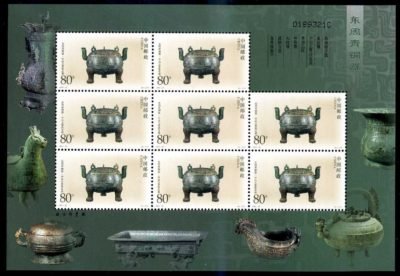
2003年特种邮票《东周青铜器》
国家邮政局2003年12月13日发行《东周青铜器》特种邮票1套8枚。
(8-1)T 龟鱼纹方盘 60分 890万枚
(8-2)T 秦公簋 60分 890万枚
(8-3)T 中山王厝铁足鼎 80分 950万枚
(8-4)T 曾侯乙匝 80分 950万枚
(8-5)T 神兽尊 80分 950万枚
(8-6)T 凤纹尊 80分 950万枚
(8-7)T 莲鹤方壶 1元 890万枚
(8-8)T 龙兽提梁盉 2元 880万枚
志号:2003-26
版别:影雕套印
邮票规格:50×30mm(第1~4图)、30×50mm(第5~8图)
齿孔度数:11.5度
整张枚数:版式一16(4×4)、版式二 8枚(仅第三枚)(发行55万版)
版式二边饰设计者:郝旭东
邮票设计者:王序
雕刻者:第1、3图为李庆发;第2、6图为姜伟杰;第5、8图为阎炳武;第4、7图为郝欧
供稿:故宫博物院、中国历史博物馆、河北省文物研究所、湖北省博物馆、贺州市博物馆、镇江博物馆、浙江省博物馆
印制厂:北京邮票厂
邮票赏析:
中国古代文明的瑰宝东周青铜器设计风格纤巧、清新,采用高水平的制作工艺,极富地方性和生活色彩。春秋战国时期是中国古代青铜器铸作的又一个高潮期。春秋后期青铜器的器形设计与实用相结合,造型富于多样式,精奇新巧。失蜡铸造法在春秋后期出现,铭文的美化进程更为全面,青铜器进入了一个从器物、纹饰到铭文的全面装饰化的新阶段。国家邮政局将于12月13日发行《东周青铜器》一套8枚,图案名称:龟鱼纹方盘、秦公簋、中山王铁足鼎、虺纹禁、栾书缶、曾侯乙尊盘、莲鹤方壶、龙兽提梁为主题。
“龟鱼纹方盘”通高22.5厘米,长73.2厘米,宽45.2厘米,重23.5公斤。盘作长方体,口沿外翻,浅腹,平底,四兽首衔环,底部铸有四兽形足。口沿饰蟠螭纹,内底饰龟鱼戏水图案,内壁饰曲带纹,外壁饰云纹及浮雕怪兽,是战国青铜盘中罕见的佳作。珍藏在北京故宫博物院。
“秦公簋”通高19.8厘米,口径18.5厘米,器内共有铭文123字,记述秦国的祖先在华夏建都已经12代,威名大震,秦景公继承前辈的事业,要永保四方的土地。秦公簋出土于甘肃天水秦安县。
“中山王厝铁足鼎”采用分铸工艺制作而成。通高51.5厘米,腹径65.8厘米。盖钮与腹足部之间刻铭文77行469字,是我国迄今发现的战国时期字数最多的一篇铭文。中山王铁足鼎于1976年在平山县的中山王墓出土。
“曾侯乙匜”尊高33.1厘米,盘高24厘米,是用青铜铸成的层层叠叠的青铜透空附饰,附饰玲珑剔透、层次丰富、节奏鲜明,是由非常先进的失蜡法铸造而成,是春秋战国时期最复杂、最精美的青铜器件,被称为绝无仅有的稀世珍品。曾侯乙尊盘在湖北曾侯乙墓中出土。
“莲鹤方壶”高122厘米,宽54厘米,重64公斤。方壶形体巨大。双层镂雕莲瓣盖上立有一只展翅欲飞、引颈高吭的仙鹤。镂空的双龙耳较大,上出器口,下及器腹。壶体四面以蟠龙纹为主体纹饰,并在腹部四角各铸一飞龙。整个壶的造型优美新颖,艺术构思巧妙,是春秋中期的珍贵名器。莲鹤方壶1923年出土于河南新郑 。
Leave A Comment
You must be logged in to post a comment.