
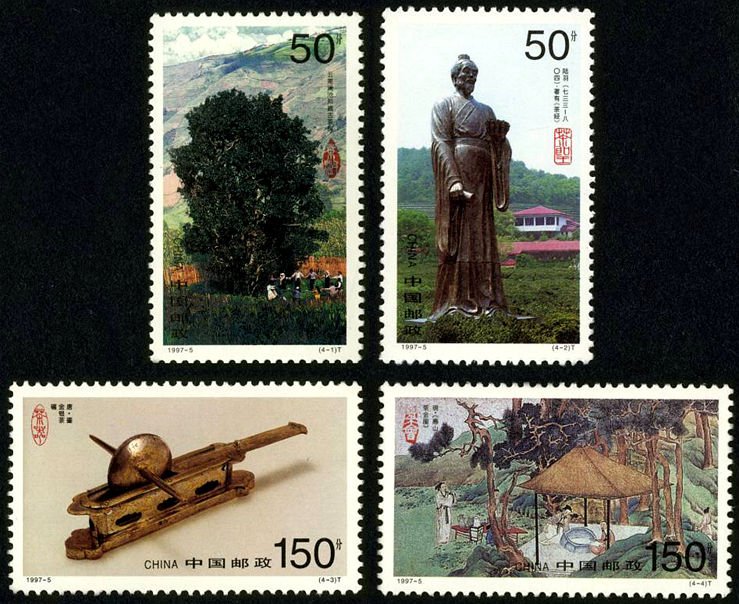
1997-05, Tea《茶》
Stamp Title: Tea
Scott No: 2756, 2757, 2758, 2759
Serial number: 1997-5
Values in set: 4
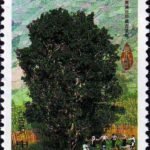
(4-1), Tea Tree, 50 fen, 30*50mm
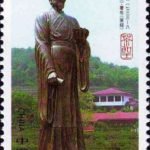
(4-2), Tea Sage, 50 fen, 30*50mm
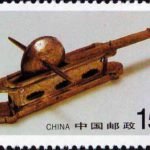
(4-3), Tea Utensils, 150 fen, 50*30mm
(4-4), Tea Party, 150 fen, 50*30mm
Date of issue: April 8, 1997
Designers: Ren Yu
Size:
30*50mm for Value 1 and 2
50*30mm for Value 3 and 4
Perforation: 12
Sheet composition: 40
Printing process: offset
China is the first country in the world which has discovered, planted and made use of the tea. Legend has it that Shen Nong, a legendary ruler who introduced agriculture and medicine, was poisoned by 72 kinds of poisonous herbs in one day when he was tasting hundreds of herbs, but was cured by tea. “Literary Expositor”, and ancient book written 350 BC also mentioned tea and its planting. China is internationally acknowledged as having nearly 4,000 years of history of planting tea.
Tea was originally planted in Sichuan. After the Qin Empire conquered the State of Shu, tea was extensively planted else-where. In the Qin and Han dynasties, people used tea as medicine, and later as a drink to clear away heat and toxic material. Hua Tuo of the Three Kingdoms said in his “On Food” that drinking bitter tea was beneficial to health. At present, commodity tea is generally divided into six kinds: green tea, such as Dragon Well, Biluochun, Zhenmei, Zhucha and Huangshan Maofeng; yellow tea, which is covered tightly and turns yellow in the course of processing, such as Junshan Yinzhen and Mengding Huangya; black tea, which turns black after being piled, such as Hubei Laoqingcha and Hunan Black Tea; white tea, which is in thin pieces and not fried, such as Baihao Yinzhen and Gongmei; Qingcha tea, which is a semi-fermented tea, and has the mellow taste of black tea and fragrance of green tea, such as Wuyiyan Tea and Wulong Tea; black tea, a fully-fermented tea, such as Qimen Black Tea. It is estimated that half of the world’s population drink tea. The etiquette of drinking tea has been introduced to Japan where it integrated the preaching of Zen and became the Tea Ceremony involving religion, art , moral, philosophy, personal cultivation and social etiquette.
According to the statistics, China’s tea output has increased from 41,000 tons in 1949 to 590,000 tons in 1996. China Ranked third in the world in terms of output in 1949, and has ranked second since 1978.
-

- (4-1), Tea Tree, 50 fen, 30*50mm
-
- (4-2), Tea Sage, 50 fen, 30*50mm
-
- (4-3), Tea Utensils, 150 fen, 50*30mm
-
- (4-4), Tea Party, 150 fen, 50*30mm

1997年特种邮票《茶》
国家邮政局1997年4月8日发行《茶》特种邮票1套4枚。
T(4-1) 茶树 50 分 3149.75万枚
T(4-2) 茶圣 50 分 3149.75万枚
T(4-3) 茶器 150 分 2551.75万枚
T(4-4) 茶会 150 分 2551.75万枚
志号名称:1997-5T
版别:胶印
4整版枚数:40 枚
全套面值:4.00元
邮票规格:30×50毫米
齿孔度数:12 度
设计者:任宇
印制机构:河南省邮电印刷厂
茶,又称“茗”,常绿灌木及乔木型植物,源于中国,现已成为世界三大饮料之一。据载中国人饮茶已有四五千年历史,形成了独特的中国茶文化。茶自唐代开始流传海外,逐步传播与世界。这是中国对人类的一大贡献。
茶是一种起源于中国的由茶树植物叶或芽制作的饮品。也泛指可用于泡茶的常绿灌木茶树的叶子,以及用这些叶子泡制的饮料,后来引申为所有用植物花、叶、种子、根泡制的草本茶,如“铁观音”等。茶叶作为一种著名的保健饮品,它是古代中国人民对中国饮食文化的贡献,也是中国人民对世界饮食文化的贡献。
1997年4月8日,为宣传和弘扬中国茶文化,邮电部发行了《茶》特种邮票,全套4枚。
Leave A Comment
You must be logged in to post a comment.