
Serial number: 1996-21
Values in set: 4
Date of issue: August 22, 1996
Designers: Zou Jianjun
Size of stamp: 30*40mm
Perforation: 11.5
Sheet composition: 40
Printing process: gravure
-

- (4-1), Mausoleum Terrace, 20 fen, 30*40mm

-
- (4-2), Ornament on Divine Gate, 20 fen, 30*40mm
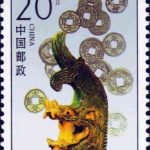
-
- (4-3), Stone Terrace and Stele Pavilion, 50 fen, 30*40mm
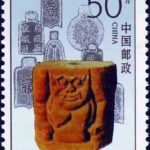
-
- (4-4), Remnant Stele at Shouling, 100 fen, 30*40mm

The Western Xia Tombs, known “Oriental Pyramids”, is located in east Mount Helan, west of Yinchuan City of Ningsia Hui Autonomous Region. Scattered in the 50 square-kilometer area, there are 9 emperors’ tombs and more than 200 tombs containing figurines or objects buried with the emperors.
The Western Xia regime was a Dangsiang nationality dominated feudal kingdom, founded in northwestern China in about the beginning of 11th century to the beginning of 13th century. A branch of the ancient Qiang Nationality, Dangxiang became booming during the turning period of the Sui and Tang dynasties and set up a strong separatist regime by force of arms. In 1038, Li Yuanhao proclaimed himself emperor, with a reigning title of “DaXia”, and built capital in Xingqing Prefecture (today’s Yinchuan City); thus formally established a separatist regime. In 1227 it was overthrown and perished by the Mongolian troops.
At its zenith, Western Xia’s territory covered “thousands of square kilometers, including sands to the east of the Yellow River, Yumen Pass in the west; in the south it bordered the Xiaoguan Pass, and controlled the great deserts in the north”. The regime constituted its unique systems of politics, military, education and law, and forged coins as its own currency and invented its own written language. The glorious history and splendid culture Western Xia created were exemplified in the grandiose emperors tombs and in the cultural relics and ancient books and records scattered in various areas.
Each of the emperor’s tombs is in fact a separate complex facing south, with surrounding city walls, side towers and god walls. On the center of the south end of the god walls there were symmetrical watch platforms on the left and right sides, with towers built on them. There are still destroyed tablets remained in a tablet pavilion in the north of the tombs, describing the life story of the dead in both Chinese and Western Xia languages. The far west side of the Western Xia Tombs was the ruined site of the God Palace, where sacrifice ceremonies were held. On the rear of the palace were tall and grand funeral parks, eight-side, five or seven-storied pavilion style buildings, which are unique among Chinese cemetery architecture. The Western Xia was submerged by the Yuan Dynasty, only leaving the dilapidated walls and pyramid-like grave mounds, reminding people of the historical Western Xia regime.

1996-21, Mausoleums of Western Xia《西夏陵》
中国国家邮政局1996年8月22日发行《西夏陵》特种邮票1套4枚。
(4-1)T 陵台 20 分 4173.7万枚
(4-2)T 神门鸱吻 20 分 3799.7万枚
(4-3)T 碑亭石座 50 分 2485.7万枚
(4-4)T 寿陵残碑 100 分 2165.7万枚
志号名称:1996-21T
版别:影写
整版枚数:40 枚
全套面值:1.90元
邮票规格:30 × 40毫米
齿孔度数:11.5 度
设计者:邹建军
印制机构:北京邮票厂
Leave A Comment
You must be logged in to post a comment.