
Stamp Title: Dunhuang Murals (6th series)
Serial number: 1996-20
Values in set: 4
Souvenir sheet: 1
Date of issue: August 15, 1996
Designers: Wu Jiankun; Ren Yu
Size of stamp:
40*54mm , 54*40mm
Size of S/S: 96*135 mm
Size of S/S stamp: 40*102 mm
Perforation: 12
Sheet composition: 40
Printing process: gravure
-

- (4-1), Illustration of Mount Wutai, 10 fen, 40*54mm
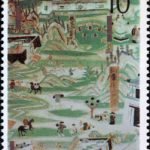
-
- (4-2), King of Khotan, 20 fen, 40*54mm

-
- (4-3), Savior Avalokitesvara, 50 fen, 54*40mm
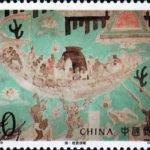
-
- (4-4), Worshipping Bodhisattvas, 100 fen, 54*40mm
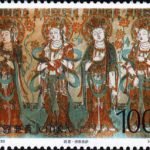
Located on the west edge of the Hexi Corridor in western Gansu, China, Dunhuang Grottoes, always known as a “Buddhist art treasury”, is one of the country’s largest ancient grotto group, a key cultural relics unit under State protection. The Dunhuang Grottoes in a broad sense include the Dunhuang Mogao Grottoes, the Xi Qianfodong Grottoes, Yulin Grottoes in Ansi, Qianfodong Grottoes in Shuikouxia, which are usually referred to as Mogao Grottoes. The Mogao Grottoes were inaugurated in the 2nd year of Jian Yuan of the early Qin Dynasty (AD 366), but the earliest grottoes extant were dug during the sixteen Kingdoms of Bei Ling (421 to 439 AD). The construction of the grottoes continued in dynasties including Northern Wei (386-534), Western Wei (535-556), Northern Zhou (557-581), Sui, Tang, Five Dynasties and Ten Kingdoms (907-960), Song, Western Xia (1038-1227) and Yuan. The number of grottoes extant totaled 492, and the murals within the grottoes cover an area of about 45,000 square meters; besides there are 2,400 clay sculptures in the Dunhuang Grottoes.
What the Dunhuang murals mainly depict fall into four categories: The Jing Bian, stories illustrating Buddhist scripture; The Ben Sheng story, the previous incarnation life stories of Sakyamuni (the founder of Buddhism); The Buddha, arhat and little Qianfo; and the portraits (with real names )of those who had contributed to the construction of the grottoes or offered sacrifices to the Buddhas. The murals in Northern Wei period, representatives of the early style murals, were drawn in bold and vigorous lines, which looked natural and flowing. However, most lines have already peeled off, and the colors, faded, The mural style in the Sui Dynasty became smooth and vivid, with rich and yet soft colors, The Dunhuang mural art reached its climax in the Tang Dynasty, when lines became thicker and smoother, colors ,richer and more sophisticated. Generally the murals were magnificent, picturing vast ranging subjects. The murals in the Five Dynasties and Ten Kingdoms and early Song Dynasties followed Tang, with natural folk art styles. And in the Yuan Dynasty, murals were painted with dark and gloomy, and seldom red colors. The wet mural style in slight ink and wash made the murals look mysterious.
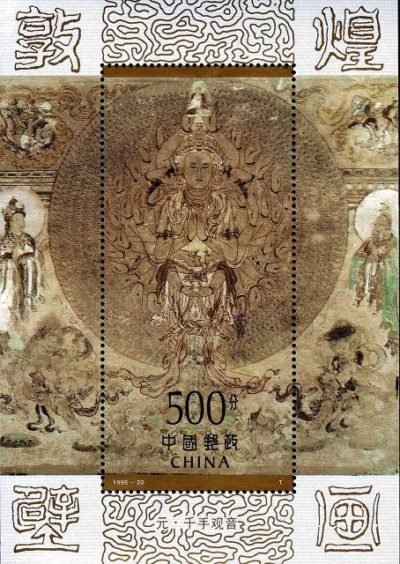
(1-1), Ten Thousand Arm Avalokitesvara, 500 fen, 96*135 mm/ 40*102 mm“元·千手观音”
The Dunhuang murals, the representatives of Chinese arts in the 4th to 13th centuries, have provided many precious materials for the research materials for the research of the history of Buddhist art.
中国国家邮政局1996年8月15日发行《敦煌壁画》特种邮票1套4枚,小型张1枚。
(4-1)T 五代·五台山图 10 分 2073.7万枚
(4-2)T 五代·于阗国王 20 分 3524.1万枚
(4-3)T 宋·观音济难 50 分 2595.9万枚
(4-4)T 西夏·供养菩萨 100 分 2051.3万枚
小型张 元·千手观音 500 分 1625.2万枚
志号名称:1996-20T
版别:影写
整版枚数:28枚
全套面值:180分
邮票规格:40 × 54毫米
齿孔度数:12度
小型张邮票规格 46×102毫米
小型张外形规格 96×135毫米
设计者:吴建坤、任宇
印制机构:北京邮票厂
Leave A Comment
You must be logged in to post a comment.