
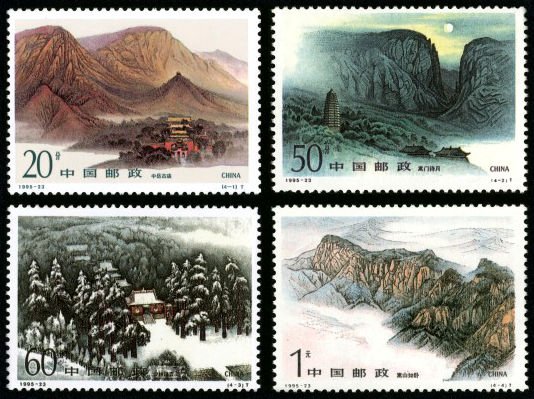
1995-23, Songshan Mountains《嵩山》
Stamp Title: Songshan Mountains
Scott No: 2628-31
Serial number: 1995-23
Values in set: 4
(4-1), Old Temple in Zhongyue, 20 fen, 54*40mm
(4-2), Songshan Mount at Moonlit Night, 50 fen, 54*40mm
(4-3), A Sunny Day After a Snow in Shaolin, 60 fen, 54*40mm
(4-4), Towering Songshan Mount, 100 fen, 54*40mm
Date of issue: November 10, 1995
Designers: Yang Wenqing and Li Defu
Engravers: Hu Zhenyuan, Yan Bingwu, Li Qingfa and Jiang Weijie
Size: 54*40mm
Perforation: 11.5
Sheetcomposition: 28
Printing process: gravure- engraving combined
Mt. Songshan that is composed of Taishi Mountain and Shaoshi Mountain is a part of the Funiu Mountains with its main body lying in the northwest of Dengfeng County, Henan Province. It extends about 60 kilometers from east to west. It was called Songgao and Chongshan in the Xia Dynasty (about 21st century-16th century B.C.), Songgao in the Shang Dynasty (about 16th century-11th century B.C.) and Yueshan in the Western Zhou Dynasty (about 11th century-771 B.C.). Songgao was taken as the central Lofty of the Five Sacred Mountains in the Eastern Zhou Dynasty (770-256 B.C.). The mountain was called Mt. Songshan the Central Lofty Mountain after the Five Dynasties (907-960) . The other four sacred mountains are Mt. Taishan in Shandong, Mt. Huashan in Shanxi, Mt. Hengshan in Shanxi and Mt. Hengshan in Hunan . On Mt. Songshan, there are undulating hills and steep peaks. In history the 72 peaks of the mountain were named according to their locations and shapes and the ruins of celebrities, such as the sun, the moon, jade pillar, phoenix, lion and white deer.
Songding, also called Junjifeng, is the highest peak of Mt. Songshan, on which the Yellow River is in sight as a flickering ray to the north and scenic spots and historical sites can be seen scattered in hills around. The most famous places of historical interest include the Songyue Temple Pagoda of the Northern Wei (386-534), the Three Watchtowers in Mt. Songshan of the Later Han (25-220), the observatory of the Yuan Dynasty (1271-1368), and Shaolin Temple, Zhongyue Temple, etc. The are all tourist attractions.
-

- (4-1), Old Temple in Zhongyue, 20 fen, 54*40mm
-
- (4-2), Songshan Mount at Moonlit Night, 50 fen, 54*40mm
-
- (4-3), A Sunny Day After a Snow in Shaolin, 60 fen, 54*40mm

-
- (4-4), Towering Songshan Mount, 100 fen, 54*40mm
1995年特种邮票《嵩山》
国家邮政局1995年11月10日发行《嵩山》特种邮票1套4枚。
(4-1)T 中岳古庙 20 分 3146.7万枚
(4-2)T 嵩门待月 50 分 3041.1万枚
(4-3)T 少林晴雪 60 分 2615.5万枚
(4-4)T 嵩山如卧 100 分 2769.5万枚
志号名称:1995-23T
版别:影写、雕刻
整版枚数:28 枚
全套面值:2.30元
邮票规格:54 × 40毫米
齿孔度数:11 度
设计者:李德福、杨文清
雕刻者:呼振源、阎炳武、李庆发、姜伟杰
印制机构:北京邮票厂
五岳,是我国古代以中原为核心,在东、南、西、北、中5个方位上选定的5座名山的简称。五岳制始于汉代,当时的五岳为东岳泰山、西岳华山、南岳天柱山、北岳大茂山、中岳嵩山。隋文帝时将南岳改为衡山,明代时又把北岳改为恒山,自此,五岳便固定下来,一直沿用至今。
中岳嵩山是我国著名的五岳之首,古称外方,属伏牛山系,是方山山脉的一部分,东西横卧,绵延约60余公里。地跨新密、登封、巩义、偃师、伊川等地,主体部分位于河南登封市西北,由东部的太室山和西部的少室山两座高、中山组成。在先秦时代,嵩山被认为是座沟通天地的神山,夏、商、周三代的帝王,都曾在嵩山祭祀天帝,以宣示自己是受命于天的天子,祈求神灵的福佑。认为嵩山是神山,古籍中多有记载。北宋以来,均称中岳嵩山。
太室山和少室山两山巍然高耸对峙,直插云霄,两山各有36峰,嵩山最高峰名峻极峰,海拔1440米。嵩山没有很突出的奇峰,而是东西起伏为眠龙状;侧卧在中州大地之上;所以古人称赞嵩山的形象美曰:“嵩山如卧”。登临峰顶,极目远眺,北望黄河,鸟瞰山麓,名胜古迹星罗棋布。群峰挺拔,气势磅礴,景象万千。由峰、谷、涧、瀑、泉、林等自然景素构成的中岳二十景,嵩门待月、箕阴避暑、石淙会饮等,这些自然景观或雄壮魁伟、秀逸诱人,或飞瀑腾空、层峦叠嶂、多彩多姿。嵩山林木葱郁,一年四季迎送风雪雨霜,生机昂然。峻极峰上松林苍翠,山风吹来,呼啸作响,轻如流水潺潺,猛似波涛怒吼,韵味无穷。嵩山秋色,少室红叶更是迷人。少室山山势陡峭险峻,奇峰异观,比比皆是。登上山顶环顾四周,群山碧绿,林海荡漾,雪雾飘渺如临仙景。灵霄峡、大仙峡、响潭沟、掛冰崖、水帘洞、回音楼,景物天成,引人入胜。嵩山原本是一座道教名山,现存的中岳古庙始建于秦,是道教在嵩山最早基地,之后已发展为道、释、儒三教荟萃之地,为后人留下了丰富多彩的人文景观,使其成为著名的风景区。共分为五大景区,即少林寺景区、中岳庙景区、嵩阳书院景区、三皇寨景区和观星台景区。
1995年11月10日,为了展现中华山河的壮美风貌,邮电部发行了《嵩山》特种邮票,全套4枚。
Leave A Comment
You must be logged in to post a comment.