
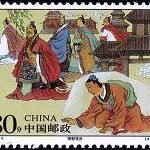
The idiom “Trying to learn the Handan Walk” (pinyin: hán dān xué bù ) originated from a story about a native of the State of Yan who went to Handan to learn the walk manner of the people of the State of Zhao, only to forget his own manner of walk, and had to crawl back home. The expression is used to ridicule those imitating others blindly.
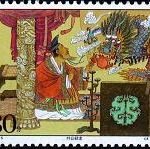
According to the story of “Lord Ye’s Love for Dragon” (pinyin: yè gōng hào lóng or shè gōng hào lóng), Lord Ye was fond of dragons and had his house decorated with their images. But when a real dragon came to visit him, he was scared out of his wits. It is used to indicate professed but false enthusiasm.
“Filling a Position in a Yu Band” (pinyin: làn yú chōng shù) came from a story about a Mr. Nanguo who was not able to play the yu but make up a number in the band playing for King Xuan of the Qi state. King Xuan’s successor, King Min, preferred solos of the yu, and Mr. Nanguo had to sneak sway. The expression is used to ridicule those with no real talent.
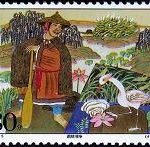
In the story of “When the snipe and the Clam Grapple” (pinyin: yù bàng xiāng zhēng), the snipe pecked the flesh of the calm and the latter clamped its beak. A fisherman too the opportunity and caught them both. It is used to describe the situation where a third party benefits from the fight between two parties.
-

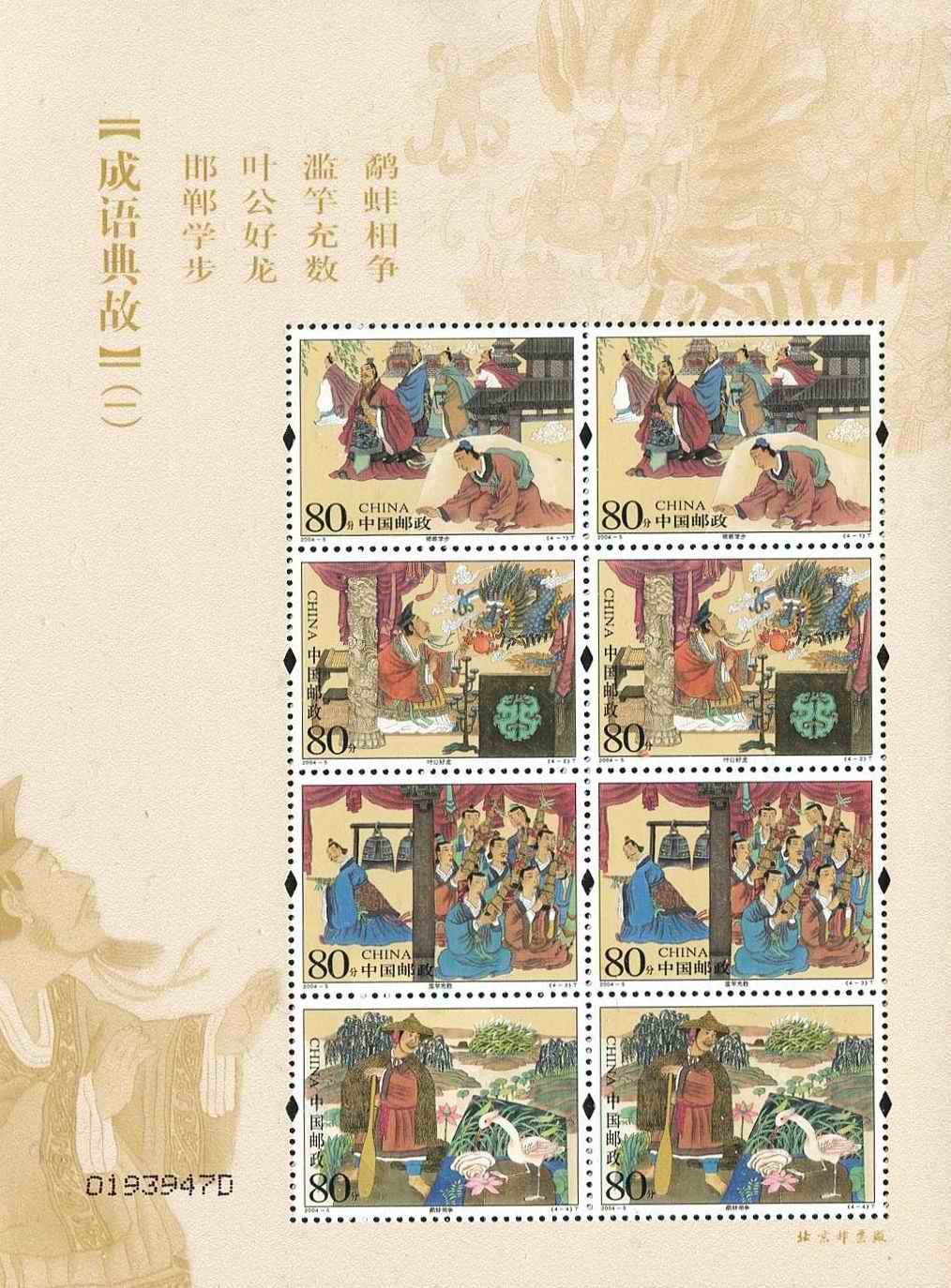
- (4-1), Trying to Learn the Handan Walk, 80 fen, 40*30 mm
-
- (4-2), Lord Ye’s Love for Dragon, 80 fen, 40*30 mm
-
- (4-3), Filling a Position in Yu Band, 80 fen, 40*30 mm

-
- (4-4), When the Snipe and the Clam Grapple, 80 fen, 40*30 mm
Stamp Title: Stories of Idioms I
Serial number: 2004-5
Values in set: 4
Denomination: 3.20 yuan
Date of issue: 2nd April 2004
Designer: Li Yongqing and Li Guozhu
Size of stamps: 40*30 mm
Perforation: 12.5*13.5
Sheet composition:
20 for Sheet I; 8 for Sheet II (se-tenant)
Printing process: gravure
Printer: Beijing Postage Stamp Printing House
Knowing China through Chinese Stamps.
2004年特种邮票《成语典故(一)》
国家邮政局2004年4月2日发行《成语典故(一)》特种邮票1套4枚。
(4-1)T 邯郸学步 80分 1230万枚
(4-2)T 叶公好龙 80分 1120万枚
(4-3)T 滥竽充数 80分 1110万枚
(4-4)T 鹬蚌相争 80分 1060万枚
志号:2004-5
版别:影写
邮票规格:40×30毫米
齿孔度数:12.5×13.5度
整张枚数:版式一20(5×4)、版式二8枚(2套邮票)(发行95万版)
整张规格:版式一240×150毫米、版式二 130×176毫米
邮票设计者:李永清、李国柱
版式二边饰设计者:李国柱
印制厂:北京邮票厂
中国邮政定于2004年4月2日发行《成语典故(一)》特种邮票1套4枚
“邯郸学步”【拼音是hán dān xué bù,比喻一味地模仿别人,不仅没学到本事,反而把原来的本事也丢了。出自《庄子·秋水》。】讲的是战国时代,燕国寿陵有个少年,听说邯郸人走路很好看,就赶去邯郸跟人家学习步法。但他不仅没有掌握邯郸人走路的方法,而且忘记了自己原来走路的步法,结果只好爬着回家了。这个成语比喻模仿别人不得法,反面把自己原有的本领也丢掉了。
“叶公好龙”【拼音是yè gōng hào lóng(叶,现读yè,旧读shè),比喻口头上说爱好某事物,实际上并不真爱好。出自《新序·杂事五》】讲的是春秋时期楚国叶(今河南叶县)的叶公子高很喜欢龙,家里到处都画着龙。天上的龙知道了,就来到他家,龙从窗户上向里看。叶公一看吓得面无人色,失魂落魄。以后,人们就讽刺那些只是口头上说喜欢,实际却不一致的人为“叶公好龙”。
“滥竽充数”【làn yú chōng shù 】这一故事发生在战国时代,齐国宣王爱听吹竽,每次都要三百人一齐吹奏,不会吹竽的南郭先生也混在里面充数。宣王死后,齐湣(mǐn)王继位,要他们一个个地吹,南郭先生就逃跑了。后用此成语比喻无本领的冒充有本领,或次货冒充好货。
“鹬蚌相争”【拼音是yù bàng xiāng zhēng,意思是比喻双方相持不下,而使第三者从中得利。“鹬蚌相争,渔翁得利”的省语。出自清·湘灵子《轩亭冤·哭墓》】是战国时苏代为燕国到赵国当说客讲的一个故事。他说他在来赵途中,经过易水,河蚌正张开壳晒太阳,鹬鸟伸嘴去啄它的肉,河蚌急忙合起两张壳,紧紧地钳住鹬鸟的嘴巴。它们两个谁也不肯松口。有一个渔夫看见了,便走过来把它们一起捉走了。比喻双方相持不下,第三者因而得利。
2010-09, Stories of Idioms (II)《成语典故(二)》
[…] 相关:2004年特种邮票《成语典故(一)》 […]