
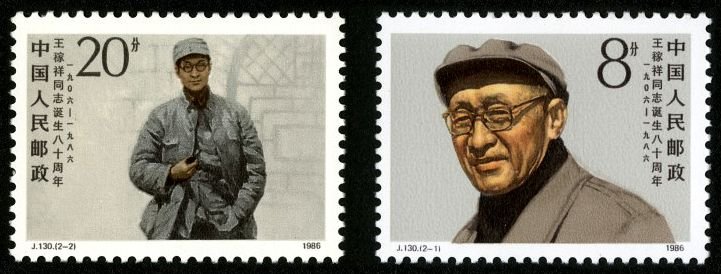
J130, 80th Anniv. of Birth of Wang Jiaxiang《王稼祥诞生八十五周年》
Stamp Title: 80th Anniv. of Birth of Wang Jiaxiang
Scott No: 2042, 2043
Serial number: J130
Values in set: 2
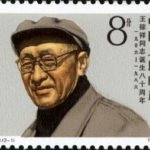
(2-1), Portrait of Wang Jiaxiang, 8 fen, 40*30 mm
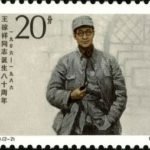
(2-2), Wang Jiaxiang in Yan’an, 20 fen, 40*30 mm
Date of issue: August 15, 1986
Denomination: 28 fen
Designers: Sun Weimin
Size of stamps: 40*30mm
Perforation: 11*11.5
Sheet composition: 50(5*10)
Printing House: Beijing Postage Stamp Printing Works
Born in Jing County, Anhui Province, Wang Jiaxiang went to the Soviet Union and studied in the Sun Yat-sen University in Moscow. In 1928, he joined the Communist Party of China in the Soviet Union. He returned home in 1930 and after that he served as Director of the Propaganda Department of the CPC Central Committee, Secretary General of the Committee of Newspapers of the Central Committee of the Party, and Editor in chief of two newspapers, “Red Flag” and “Truth.” In 1931, he went to the Revolutionary Base of the Central Committee of the Communist Party and served as member of the Central Bureau of the Soviet Area, and Director General of the General Political Department of the Chinese Workers’ and Peasants’ Red Army. He was elected member of the Central Executive Commission of the Chinese Soviet Republic, Vice Chairman of the Central Military Commission, Member of the People’s Commission in charge of foreign affairs, and Director General of the General Political Department of the Red Army. In 1934, he was elected member of the Central Committee of the CPC, Alternate Member of the Political Bureau of the Central Committee of CPC, and then member of the Political Bureau. In the course of the Long March, he was member the three-person military commanding group of the Central Committee. He served as Representative of the Central Committee of the CPC in the Communist International from 1937 to 1938. In 1938, he returned to Yan’an and served as Vice Chairman of the Central Military Commission, Director General of the General Political Department, President of the Military and Political Institute of the Eighth Route Army, Member of the North East China Bureau of the Central Committee of the CPC, Director General of the Department of Urban Work, and Acting Director General of the Propaganda Department. During this period, he was elected Alternate Member of the Central Committee, and member of the Central Committee. In July 1949, he took part in the delegation of the Central Committee to the Soviet Union, led by Liu Shaoqi to talk on the establishment of embassies. After the founding of the People’s Republic, he was the first Ambassador to the Soviet Union (1949-1951) and Minister of the International Liaison Department (1951-1966). During his tenure of the two positions, he took part in the making of many important decisions on foreign affairs by the Central Committee and the State Council. He attended the negotiations and conclusion of the Sino-Soviet Treaty of Friendship, Alliance and Mutual Assistance. He was member of the delegation of the CPC headed by Liu Shaoqi to attend the 19th Congress of the Communist Party of the Soviet Union. In 1953 he concurrently held the position of Chief of the Guiding Committee on the International Activities of the Central Committee of the CPC. In 1954, he attended the Geneva Conference on Korea and Indo-China. He attended the 20th Congress of the Communist Party of the Soviet Union. In 1956, he was elected member of the Central Committee and Secretary General of the Secretariat of the Central Committee of the CPC. At the beginning of the 1960s, based on the domestic and international situations, he put forward four proposals on the adjustment of foreign policies and tactics, i.e. 1) to release a statement to expound accurately and comprehensively that our foreign policies are peaceful; 2) it was necessary to take an approach of relaxation in foreign policy so as to avoid the increase of tension; 3) to pay attention to tactics in the international struggles and keep highly vigilant against schemes to isolate and separate China; and 4) we must take a realistic attitude to foreign assistance so as not to overstrain ourselves.
-

- (2-1), Portrait of Wang Jiaxiang, 8 fen, 40*30 mm
-
- (2-2), Wang Jiaxiang in Yan’an, 20 fen, 40*30 mm
J130 王稼祥诞生八十五周年
发行日期:1986.8.15。影写版。P11*11.5。 40mm*30mm。 50(5*10)。 [G]。
设计:孙为民。印制:北京邮票厂。
2-1为“王稼祥同志像”。
2-2为“王稼祥同志在延安”。图案中,王稼祥身穿八路军灰蓝色制服、手持烟斗,站在窑洞外面。
王稼祥(1906~1974),安徽泾县人。1928年加入中国共产党。曾任红军总政治部主任。1934年当选为中共六届中央委员,后选为政治局委员。遵义会议后曾任中央三人军事指挥小组成员、中共中央军委副主席、东北局城工部部长。中华人民共和国成立后,曾任首任驻苏联大使、外交部副部长、中共中央对外联络部部长、中央书记处书记等职。“文化大革命”期间,遭到林彪、江青集团的迫害,1974年1月25日逝世。
本套邮票共2枚。邮票设计一改以前同类邮票所用的照片或素描画,大胆采用细腻、生动、鲜明的水彩画手法。
2-1为“王稼祥同志像”。主体人物头戴灰帽,身穿灰呢大衣,颈系深色围巾,显得朴素庄重。面部表情和蔼谦逊、温厚可亲。眼镜后面的双眼充满了睿智深邃的光芒,将这位“红色教授”的气质和风度刻划得恰到好处。
2-2为“王稼祥同志在延安”。图案中,王稼祥身穿八路军灰蓝色制服、手持烟斗,站在窑洞外面。艺术风格与2-1相类似。
水彩画本身具有完整、厚实的特点,设计者又在文字设计上注意了与画面的搭配和对称,使整套邮票产生了较好的效果。
Leave A Comment
You must be logged in to post a comment.