
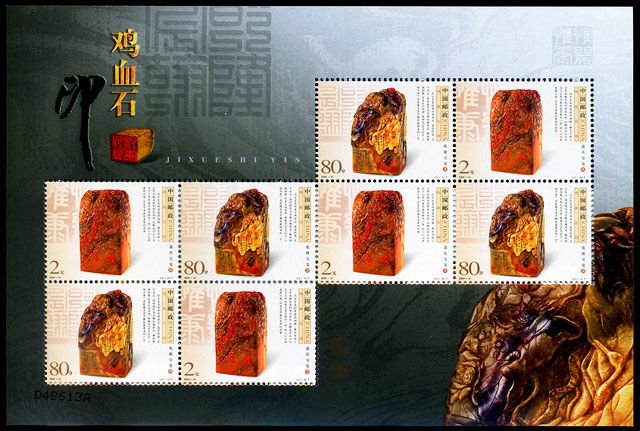
Bloodstone Seals, 1120 fen, 188*123 mm
Bloodstone is a valuable stone unique to China. It got its name from its bright red mottles like chicken blood with its content of cinnabar. As a popular material for seals, it began to be used at the end of the Yuan Dynasty over 600 years ago, and reached its prime in the Qing Dynasty. It is mainly produced in Changhua, Zhejiang Province, and Balin, Inner Mongolia, with a fine, clear, smooth texture and various patterns formed by the red mottles. It was very popular among refined men of letters and even imperial families. After the Qing Dynasty emperor Kangxi, most emperors, empresses and concubines had their seals made of bloodstone. The Emperor Qiaolong’s seal and Emperor Jiaqing’s seal shown in the pictures are from the collections of the Beijing Palace Museum.
-

- (2-2), Emperor Jiaqing’s Seal, 200 fen, 40*30 mm
-
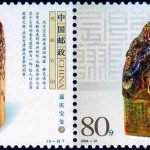
- (2-1), Emperor Qianlong’s Seal, 80 fen, 40*30 mm

Stamp Title: Bloodstone Seals《鸡血石印》
Serial number: 2004-21
Values in set: 2
Denomination: 280 fen
Date of issue: September 17, 2004
Designer: Wang Huming
Size of stamp: 40*30 mm
Perforation: 13*13.5
Sheet composition: 8 (4 sets)
Printing process: offset (with relief effect)
Printer: Beijing Postage Stamp Printing House
Knowing China Through Chinese Stamps.
中国国家邮政局2004年9月17日发行《鸡血石印》特种邮票1套2枚。
(2-1)T 乾隆宝玺 80分 1020万枚
(2-2)T 嘉庆宝玺 2元 1020万枚
志号:2004-21
齿孔度数:13×13.5度
整张枚数:8枚(四套邮票)
邮票规格:40×30毫米
整张规格:184×124毫米
版别:胶印(压凸印制)
防伪方式:防伪纸张、荧光喷码
设计者:王虎鸣
原照片提供:故宫博物院
印制厂:北京邮票厂
Leave A Comment
You must be logged in to post a comment.