
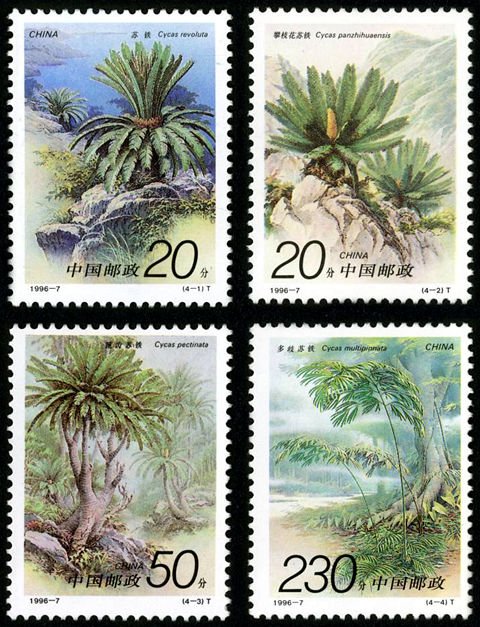
1996-07, Cycads《苏铁》
Stamp Title: Cycads
1996-7, Scott 2671, 2672, 2673, 2674
Technical details
Scott No: 2671-74
Serial number: 1996-7
Values in set: 4
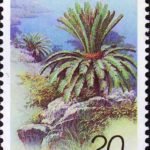
(4-1), Cycas revoluta Thunb, 20 fen, 30*40mm
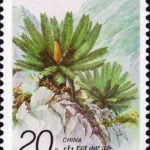
(4-2), Cycas panzhihuaensis L. Zhoun et S.Y. Yang, 20 fen, 30*40mm
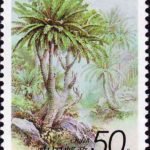
(4-3), Cycas pectinata Hamilton, 50 fen, 30*40mm
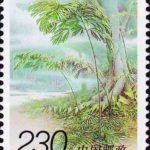
(4-4), Cycas multipinnata C.J. Chen et S.Y. Yang, 230 fen, 30*40mm
Date of issue: May 2, 1996
Designers: Zeng Xiaolian
Size: 30*40mm
Perforation: 12
Sheet composition: 50
Printing process: offset
Printing Institution: Beijing Postage Stamp Housing
Cycads, palm-shaped, has only one family-cycadaceae, and about 10 existent genera, scattering in tropical and subtropical regions. All varieties in the cycadophyta are also called cycads, which include four original gymnospermous orders: pteridospermales, cycadales, pentoxylales and bennettitales or cycadeoidales.
The cycadophyta plants were originated in the Mesozoic Era, and now only the cycadales survives. With a big palm-shaped crown, and penniform compound leaves, cycad has strobilus nesting on the top. Some cycads have tall, branchless, armor-like trunks; others have bulgy, barrel-like ones. The woodiness of cycad is both thin and soft.
Pollinated by wind, the dioecious cycads usually grow very slowly, and can be used as greenhouse ornaments. Some varieties, however, can grow outside the greenhouse. Honored as “the grand panda in the plant kingdom”, the cycad is regarded by international botanists as playing a significant role in the research of the origin and evolution of seed plants, and also the research of the vicissitudes of ancient geology and climate. The natural extinction process of the plant speeding up, people begin to take cycad as the key research and protection object.
The starch in the stems of some varieties of cycad is edible after eliminating alkaloid by cooking. The tender leaves and seeds of some cycads are also edible.
There are wild cycads scattering in the eight provinces and autonomous regions in southern China, an important cycad distribution center in the world. They include 15 varieties, all of them are of cycadaceae. On May 1 to 5, 1996, the fourth International Cycad Biology Conference was held in Panzhihua City, in southwestern Sichuan Province.
-

- (4-1), Cycas revoluta Thunb, 20 fen, 30*40mm
-
- (4-2), Cycas panzhihuaensis L. Zhoun et S.Y. Yang, 20 fen, 30*40mm
-
- (4-3), Cycas pectinata Hamilton, 50 fen, 30*40mm
-
- (4-4), Cycas multipinnata C.J. Chen et S.Y. Yang, 230 fen, 30*40mm
1996-7 《苏铁》特种邮票
(4-1)T 苏铁 20 分 3719.2万枚
(4-2)T 攀枝花苏铁 20 分 3711.7万枚
(4-3)T 蓖齿苏铁 50 分 2681.7万枚
(4-4)T 多歧苏铁 230 分 2309.2万枚
志号名称:1996-7T
发行日期:1996年5月2日
版别:胶印
整版枚数:50 枚
全套面值:3.20元
邮票规格:30 × 40毫米
齿孔度数:12 度
设计者:曾孝濂
印制机构:北京邮票厂
苏铁,即铁树,分布于热带地区,是现存种子植物中最原始的一种,被誉为活化石,是世界上重点保护的濒危植物。是铁树科的常绿棕榈状树种。其树干粗短,呈圆柱形,顶端两叉装分枝;叶大型,坚硬,羽状分裂。集生于茎顶。花雌雄异株。雄球花黄色,长圆柱形;雌球花扁球形,密被黄褐色绒毛。苏铁常载植于庭园,也可盆载供观赏用。此外,它的叶和种子可入药,茎髓可制淀粉。铁树属植物全世界有17种,我国有8种苏铁,分布于台湾、华南及西南各地。苏铁又为观赏园艺植物,并有食用和药用价值,其花不常开,被视为珍奇,有“铁树千年开花”之说。
第四届国际苏铁生物学会议于1996年5月1日至5日在我国四川省攀枝花市召开,那里有亚洲最大和分布最北的野生苏铁林和丰富的苏铁种质资源。会议以进一步推动苏铁植物研究和保护事业为目的。
1996年5月2日,为祝贺第四届国际苏铁生物学会议的召开和展示中国丰富的植物资源,邮电部发行了《苏铁》特种邮票,全套4枚。
Leave A Comment
You must be logged in to post a comment.