
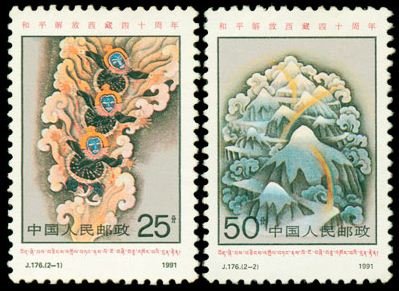
J176, 40th Anniv. of Peaceful Liberation of Tibet《和平解放四十西藏周年》
Stamp Title: 40th Anniv. of Peaceful Liberation of Tibet
Serial number: J176
Values in set: 2
(2-1), Dancing and Singing, 25 fen, 27*40 mm
(2-2), Golden Bridge, 50 fen, 27*40 mm
Denomination: 75 fen
Date of issue: May 23, 1991
Designer: Ga De
Size of stamps: 27*40 mm
Perforation: 11
Sheet composition: 50 (5*10)
Printing process: photogravure
Printing House: Beijing Postage Stamp Printing Works
May 23, 1991 marks the 40th anniversary of the peaceful liberation of Tibet and a series of activities will be held to celebrate this historic event.
At the end of 1949, the Chinese People’s Liberation Army (PLA) prepared to enter Tibet after liberating major parts of south and southwest China
Considering the specific situation in Tibet, the then central government of China noticed the local authorities of Tibet to send representatives to Beijing to hold negotiations on the peaceful liberation of Tibet.
However, the negotiations failed due to the obstruction by Tibetan upper-level reactionaries and imperialist forces.
On October 19, 1950, the PLA took over Qamdo — the gateway to Tibet, and the Tibet authorities had to accept the arrangement proposed by the central government concerning Tibet’s peaceful liberation.
In April 1951, the local authorities of Tibet sent a five- member delegation to Beijing including Ngapoi Nagwang Jigme to hold negotiations with Li Weihan and Zhang Jingwu, representatives of the Central Government. After several rounds of consultations, the two sides signed an agreement on May 23, declaring the peaceful liberation of Tibet.
According to the agreement, Tibet is a part of China; the local armed forces of Tibet became incorporated into the PLA; and the freedom of religious belief in Tibet is guaranteed.
In October 1951, the PLA came to Lhasa, the capital city of Tibet.
The peaceful liberation of Tibet was an important event in the modern history of China, as well as an epoch-making milestone in Tibetan history.
The peaceful liberation of Tibet proved that the policies of the Communist Party of China on ethnic minorities were correct and reflected the common aspiration and fundamental interests of the whole Chinese people including Tibetan people.
The peaceful liberation of Tibet laid a solid foundation for the unity and prosperity of the Newly founded People’s Republic of China.
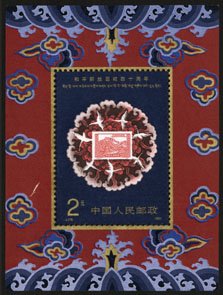
(1-1), 40th Anniv. of Peaceful Liberation of Tibet, 200 fen, 75*100 mm/ 40*54 mm mm
J176 和平解放四十西藏周年
1991.5.23。影写版。P11。 27mm*40mm。50(10*5)。 [G]。
噶德。北京邮票厂。
第1枚为 “歌舞”。它以西藏的文化为特点,用藏戏的形式来表现西藏人民欢庆解放40年。藏戏有500多年的历史, 邮票设计体现了虚实并举、现实与浪漫相结合的巧妙构思,构成画面吉祥欢乐的气氛和古朴典雅的风格。
第2 枚为“金桥”。以西藏的地理为特点。画面表现了西藏雪山高耸、连绵起伏的雪域风光。一条被藏族人民誉为 “金桥”的公路蜿蜒于群山之中。这条路是西藏经济赖 以发展的大动脉。祥云笼罩着雪山大地,象征着西藏充满了生机、祥和与希望。构图有较强的立体感,使雪山显得高远险峻、神秘莫测。
2枚邮票均在画面外上下两端设计了汉文与藏文“和平解放西藏四十周年”。
Leave A Comment
You must be logged in to post a comment.