
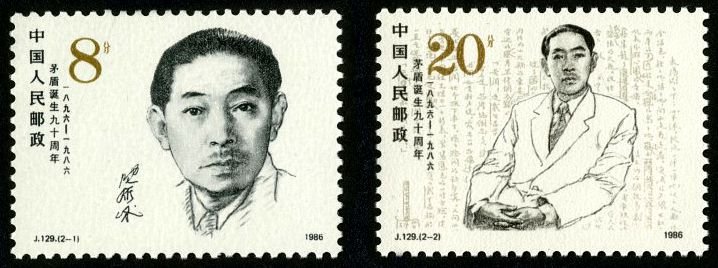
J129, 90th Anniv. of Birth Of Mao Dun《茅盾同志诞生九十周年》
Stamp Title: 90th Anniv. of Birth Of Mao Dun
Scott No: 2040-41
Serial number: J129
Values in set: 2
(2-1), Portrait of Mao Dun, 8 fen, 40*30 mm
(2-2), Mao Dun and his script of Ziye, 20 fen, 40*30 mm
Date of issue: July 4, 1986
Denomination: 28 fen
Designers: Wu Changjiang
Size of stamps: 40*30mm
Perforation: 11*11.5
Sheet composition: 50(5*10)
Printing House: Beijing Postage Stamp Printing Works
Literary innovation in modern China has been closely linked with the awakening of the Chinese nation epitomized in the May 4th Movement of 1919, which put an end to the dominance of classical language and tradition and heralded the advent of modernism. Modern literature was thus the product of a growing ideological awareness of modern ideas about democracy, socialism and the role of literature itself. The corruption permeating society and the danger the nation faced, as well as the revolutionary fervor to which these gave rise and which had its own roots in the May 4th Movement too, occupied the attention of the majority of writers, who consciously or unconsciously joined the revolutionary struggle by taking up their pens to analyze social reality. It was against this socio-historical background that the revolution began to influence literature directly and profoundly and determine the direction in which it would develop, conferring on it a historical character foreign to its precursors. Mao Dun, a versatile talent, was active during this process.
Mao Dun, whose real name was Shen Yanbing, used this pen-name when he began writing in the late 1920s. He was well known both nationally and internationally as a writer, but was at the same time a social activist. One of the earliest members of the Chinese Communist Party, he began revolutionary work in the mid-1920s and continued to take an active part in social and political struggle throughout his life. But it was literature which he made his career, one in which he achieved splendid things. National liberation and social progress were the constant goal of his writing. In him were combined the social activist and the man of letters, the writer and the revolutionary. It is nonetheless in the establishment and development of modern Chinese literature that his contributions were greatest and where his far-reaching influence can be felt today even after his death. He was truly one of the great men of modern Chinese literature.
-

- (2-1), Portrait of Mao Dun, 8 fen, 40*30 mm
-
- (2-2), Mao Dun and his script of Ziye, 20 fen, 40*30 mm
J129 茅盾同志诞生九十周年
发行日期:1986.7.4。 影写版。P11*11.5。 40mm*30m。 50(5*10)。 [G]。设计:吴长江。印制:北京邮票厂。
2-1为“茅盾头像”。
2-2为“茅盾的工作像”。画面背景是茅盾的《子夜》手迹。
茅盾(1890~1982)原名沈德鸿,字雁冰。浙江桐乡人。1921年发起组织“文学研究会”。1930年加入中国左翼作家联盟并担任领导职务。中华人民共和国成立后,他担任了第一任文化部长,并当选为历届全国人民代表大会代表、历届政协全国委员会常务委员和政协第四、五届全国委员会副主席。主要创作有小说《蚀》、《子夜》、《林家铺子》,散文《白杨礼赞》、《风景谈》,文学论著《鼓吹集》、《夜读偶记》等。这些作品刻画了中国现代社会进步的艰苦历程,绘制了规模宏大的历史画卷,提高了现实主义文学创作的水平。他的许多作品被翻译为多种外文,在各国广泛传播。1982年4月20日,中国设立了茅盾文学奖。
本套邮票共2枚。
2-1为“茅盾头像”。
2-2为“茅盾的工作像”。2-2画面表现的是茅盾充满自信的半身坐姿,背景是茅盾的《子夜》手迹,字迹清楚、秀丽。《子夜》是茅盾长篇小说中的代表作。这部小说的出版曾轰动三十年代的中国文坛。这一设计,对于反映茅盾在文学界的重要地位极为妥贴。
在绘画手法上,整套邮票的线条和浓淡处理得很好,如面部用笔浓重,突出了人物的性格,衣着用简练的线条勾勒,显得贴切自然。在票面设计上恰到好处地使用了深浅不同的色调,使整套邮票和谐统一。2-1的作者签名手迹和2-2的《子夜》平稳的安排可谓是点睛之笔。
Leave A Comment
You must be logged in to post a comment.